

Dear President Trump, Good Evening From Taipei,
Allow me to congratulate you on your successful trip to Beijing. I’ve heard the trees at Zhongnanhai are quite lovely. I cannot visit of course, since your host thinks of me as a “separatist,” which is a swear word in their country.
You can tell me more about those trees, and Beijing, and Mr. Xi when we talk. I assume we will talk since, when asked by reporters on Air Force One about selling us weapons, you replied “I have to speak to the person, you know who he is, that’s running Taiwan.”
That person, Mr. President, is me. It’s possible you forgot my name. No problem, I’ll remind you: It’s Lai Ching-te. The “te” is pronounced “de,” but you can just call me William Lai. I am the elected president of Taiwan, so I am the person who is running Taiwan. I’ve been doing so since 2024.
I hope we get to talk, because it would be helpful for me to set the record straight and ease your concerns. It seems you have many concerns when it comes to Taiwan, including the view that Taiwan is a “problem” to be “solved.”
Let’s start with Taiwan independence. Mr. Xi probably told you that he is worried Taiwan will declare independence. Or maybe he didn’t say that he’s “worried.” He probably used harsher words than that. Let me allay your fears Mr. President, I will not declare Taiwan independence because we’re already independent. We exist under the name “Republic of China,” but as you know Mr. President, that is not the same as the “People’s Republic of China” where you traveled last week.
Think of it like the “Democratic People’s Republic of Korea,” run by your not-so-democratic friend Mr. Kim Jong-un, and the “Republic of Korea” which actually does have democracy. To the rest of the world they’re known as North Korea and South Korea. Different countries, independent of each other, and using names that are different to their official titles. Imagine if President Kim were to threaten to invade South Korea should Seoul declare independence.
But as I said, Mr. President, I don’t intend to declare independence for Taiwan. Now, I may make some bold and inflammatory statements from time to time, but really that’s just pillow talk for my political base. We’re a democracy, after all, and that means keeping core constituents happy. I am sure you’re familiar with the concept.
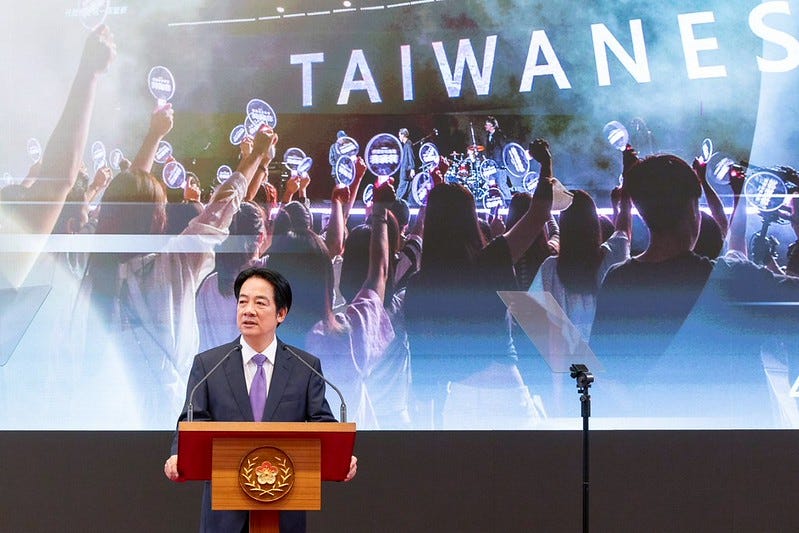
Presidential Office responds to remarks by US President Donald Trump in media interview
For example, “lock her up” and “build the wall” were quite helpful in energizing your supporters, but you didn’t actually do either and no one held you to it. Except in my case, we did lock him up. I mean, he was convicted of graft and probably did do it. But who’s to say? It’s really just convenient that our independent judiciary found one of my major political rivals guilty.
But there’s something else that’s been gnawing away at me, and 23 million of my fellow countrymen.
Chips.
You keep claiming that Taiwan took your chip industry. At first I thought it was just one of those throwaway lines aimed at shocking your audience. But you’ve said it so many times that I am starting to think you believe it.
This really isn’t true, Mr. President. Taiwan didn’t steal America’s chip industry. If anything, Mr. President, we saved it.
You needn’t take my word for it, I am a politician after all. Perhaps you could ask Jensen Huang, whom I know you listen to. Now, I cannot speak for Mr. Huang, but he has said on more than one occasion that if it wasn’t for TSMC then Nvidia wouldn’t exist.
This is indeed the truth.
You see Mr. President, Taiwan paid one of America’s ailing industrial empires a handsome sum of money in the 1970s. The year was 1976, and Taiwan’s Industrial Technology Research Institute (ITRI) signed a $3.5 million deal with Radio Corporation of America to teach our engineers how to make chips. Taiwan’s gross national product was just $1,143 per person that year, so $3.5 million was a huge sum for a developing country. But still, we paid in full. We didn’t steal.
Now, as you know Mr. President, thousands of people come to the US every year and pay large amounts to learn from prestigious institutions like the University of Pennsylvania, your alma mater. They then take that knowledge back home and apply it locally. That’s what our engineers did.
After learning from RCA, they returned home and found they’re pretty good at this semiconductor stuff. I guess you Americans are great teachers, because within months of their return our young engineering students were making chips even more efficiently than their American masters ever did.
That same year, Mr. President, an American citizen proposed a radical idea to his bosses at Texas Instruments. How about making chips for external clients instead of just for itself. This business model, known later as a chip foundry, was rejected. The Texans weren’t interested.
A decade later, that engineer-turned-executive moved to Taiwan — a place he’d never previously resided — and started the business he’d previously suggest to his superiors at that great American institution. His name, Mr. President, is Morris Chang and the company was TSMC. He stole nothing, Mr. President, in fact he’d offered that very idea and the business plan to his US employer 10 years earlier and they turned him down. He event went back to Intel and TI to see if they’d like to invest in his new startup, they again said no.
This was a missed opportunity by those two American companies, but a great win for America. That’s because, Mr. President, Taiwan’s budding chip industry was a partner to the US, not a foe. As Silicon Valley faced growing rivalry from Japan and later South Korea, Taiwan’s counterpart — the Hsinchu Science Park — became America’s biggest supporter. Qualcomm, which helped America dominate mobile phone technology for the past three decades, would have got nowhere without TSMC as a neutral party, making its chips without competing against it.
And when Apple wanted to have a US-made processor for its iPhone, America’s beloved Intel “ended up not winning it or passing on it, depending on how you want to view it.”
Instead, Steve Jobs was forced into the arms of his biggest rival, South Korea’s Samsung. Later, after accusing Samsung of stealing from him and threatening “thermonuclear war” it was Taiwan who stepped up and helped Apple extricate itself from Samsung. After an introduction by Foxconn founder Terry Gou, you remember him, TSMC’s Morris Chang built a dedicated factory for Apple in record time and at record cost. Dr Chang even agreed to develop a process node just for Apple.
What I am trying to say, Mr. President, is that the first iPhone processors weren’t even American. But Taiwan didn’t steal them. They in fact handed control over Apple’s chips back to Apple when an American couldn’t (or wouldn’t) do the job, and another foreign rival started “stealing” US technology.
Then there’s the story of AMD. After making its own chips for decades, AMD was losing far too much money to sustain the pace of innovation. No one stole anything from AMD, it just couldn’t keep up, so it sold its manufacturing business. Not to Taiwan, but to a group of Middle East investors who dubbed it Globalfoundries.
But those new UAE owners didn’t necessarily have the interests of AMD, or America at heart. Mr. President, these Emirati owners extracted a promise from AMD that all its best chips would be made at Globalfoundries. Unfortunately, Globalfoundries wasn’t very good. They were so bad, in fact, that AMD paid the Emirates-owned company to not make its chips. That’s right, Mr. President, a storied American company had to pay its foreign-owned supplier for the right to not make its products for them.
However, who do you think saved AMD? You guessed it, Taiwan.
When that 10-year exclusivity deal finally expired in 2019, AMD went straight to TSMC. And what happened next will amaze you. Within two years of being unshackled from its unfair deal, revenue doubled. Within four years, AMD revenue had climbed four-times. This is not gossip or hearsay, Mr. President, these are facts documented in detail by the great American AMD.

So we come back to Nvidia. Another great American company that wouldn’t exist without TSMC. When a young startup founder with great ideas and courage, but no reliable manufacturing partner and almost no money sent a letter to Taiwan in 1997, he was astounded by the response. Jensen Huang was desperate. But instead of being dismissed for being too small or irrelevant, Dr Chang called Mr. Huang directly, and then met with him in person. He promised that TSMC employees would 'jump through hoops' for Nvidia. And they’ve continued to do so for three decades.
If you want to learn more about stolen businesses and technology, Mr. President, I invite you to contact folks at T-Mobile, Boeing, GE Aviation, Cisco and Google. Each of them can provide accounts of their own technology being stolen, by China.
You see, Mr. President, we don’t have any need or interest in stealing from our friends. And we still see the US as a friend.
This is a point of conflict in Taiwan now, actually. My opponents accuse my government of being too close to the US. These political rivals, from the Chinese Nationalist Party (KMT), feel Taiwan should be a little more distant from Washington and a little closer to Beijing. Your continued complaints that Taiwan stole a key industry from America make my case tougher by the day, even despite the fact that Washington’s historic support for Taiwan is a key reason why the KMT survives to this day.
I understand that you need to look after your people and your own political interests, and that bashing Taiwan is useful in achieving that. Like you, I am also an elected leader who first came to power with less than a majority of the vote. But, hey, we didn’t make the rules! Amirite?
Still, despite this Taiwan-bashing, our companies are still investing in America. Foxconn, whom you once boasted was going to build “the Eighth Wonder of the World” in Wisconsin, is making amends for that broken promise. In fact, it’s now making more of its AI servers in the US than anywhere else. TSMC is following through on its commitment to expand in Arizona, and many more companies including Quanta and WiWynn are spending their own money to help you “Make America Great Again.”
You may not be aware, Mr. President, but Taiwanese companies did more to boost American computer and electronics manufacturing in the ten years through 2023 than Chinese businesses did. Our $7.3 billion in foreign direct investment in the US outweighs $6.6 billion from China, and that’s before the massive influx from TSMC really kicked in. Then there’s the massive increase to $165 billion which TSMC has promised as a result of your superb leadership. Is there any Chinese company which has promised you anything close to this figure?
Mr. President, I am not complaining. Politics is politics, and for a man who wrote The Art of the Deal, I understand that these statements about Taiwan stealing your chip industry might be just part of your negotiating tactic. But I wouldn’t be doing my duty, as the man “that’s running Taiwan,” if I didn’t correct the record.
Yet, on another point of record, I should also thank you for your fine display of statesmanship. You told the press, when asked about Mr. Xi’s warnings over Taiwan, that you “heard him out” yet “made no commitments.”
I take this response as you showing the world that you didn’t let Mr. Xi box you into a corner. Any lesser leader would have either pushed back or cowered, you did neither.
I have also held my ground. After months of wrangling and politicking, our government has finally succeeded in pushing through a special defense budget which will allow Taiwan to purchase more than $24 billion in US weapons. That means more money for great American companies like RTX Corp and Lockheed Martin.
In summary, Mr. President, we didn’t steal your chip industry and we are willing to pay for our own defense.
But I have a favor to ask. When you do make the call, which I am most looking forward to, I hope it’ll be to tell me you’re approving the arms sale my DPP government expended a lot of political capital trying to fund.
You see, we too have an election coming up, and I’d hate to resort to waving the Taiwan independence flag in order to win votes. But if I do, don’t worry, it’s just politics.
Lai Ching-te (William)
President of Taiwan (aka Republic of China)
Thanks for reading.
Readers: This is satire, written by Tim Culpan for Culpium. It was not written by President Lai Ching-te of Taiwan.
Great article. My only minor quibble: Broadcom probably deserved a mention too.
And yes, I realize the Philips story may not fit neatly here since Philips wasn’t a Taiwanese company, but I’ll digress responsibly, unlike certain current presidents encountering an issue he doesn't understand, .
As I’ve mentioned before, I knew Dick Thurston, who, handled the TSMC licensing deals after 2000 — and possibly earlier, when he was still in private practice. That history feels worth including because it adds another layer to how these relationships and licensing structures actually developed, rather than pretending than a grievance likely over being rejected by a hot Asian girl in the 80s and a tariff tantrum.
This is a satire. this is Lai. He is a joke.