

GlobalWafers Has a Texas-Sized Problem
[Exclusive] A proposed cement plant puts the silicon-wafer maker's Sherman site under a cloud, one that will remain until the Texas administration decides what it really wants.

Good Evening from Taipei,
A decade of acquisitions by GlobalWafers and its parent Sino-American Silicon vaulted the Taiwanese company into the top echelons of semiconductor wafer suppliers just as the world’s hunger for chips became even more ravenous.
But that momentum is under threat in Texas where the Lone Star State and the Federal Government need to make tough decisions about industrial policy, according to my sources.
I talked to numerous people over the past few months who are familiar with GlobalWafers’ $7.5 billion Texas project to get an understanding of what’s happening there, and why it matters. This includes a brief interview with company Chairman Doris Hsu.
What I learnt is that also under threat, beyond the Taiwanese company’s massive investment, is America’s long-term plans to develop semiconductor independence.
It’s the story of old industry versus new. Traditional manufacturing versus high-tech, entrenched interests versus newcomers. And of course, politics and lobbying.
Interestingly, the future of the nation’s chip-resilience strategy could be swayed by a team of researchers at the University of Texas and their much-anticipated report due by the end of Summer.
Luring the Taiwanese
While TSMC got a lot of the glory for its $65 billion investment in Arizona, GlobalWafers also joined the CHIPS Act program with its $3.5 billion plan to build a new wafer-making facility in Sherman, Texas. The company already had a small footprint in the area through its 2008 purchase of GlobiTech, but this fresh project would really put Texas on the map. When complete, the factory would give America its largest silicon-wafer foundry, offsetting the global production imbalance which tilts toward East Asia.
To lure GlobalWafers, Biden’s Commerce Department awarded the company $406 million in direct funding to cover both the Texas plant and a smaller facility in St. Peters Missouri. Local governments also offered incentives.
When Trump returned to office, his administration quickly set about securing further promises from Taiwan’s chip sector. TSMC Chairman and CEO CC Wei went to the White House to add $100 billion to his earlier pledge. GlobalWafers played its part by doubling its commitment to $7.5 billion.
In addition to securing its place in the US market, the Texas facility would further cement GlobalWafer’s position as the world’s third-largest supplier of silicon wafers behind Japan’s Shin-Etsu and SUMCO.
But cement is the problem.
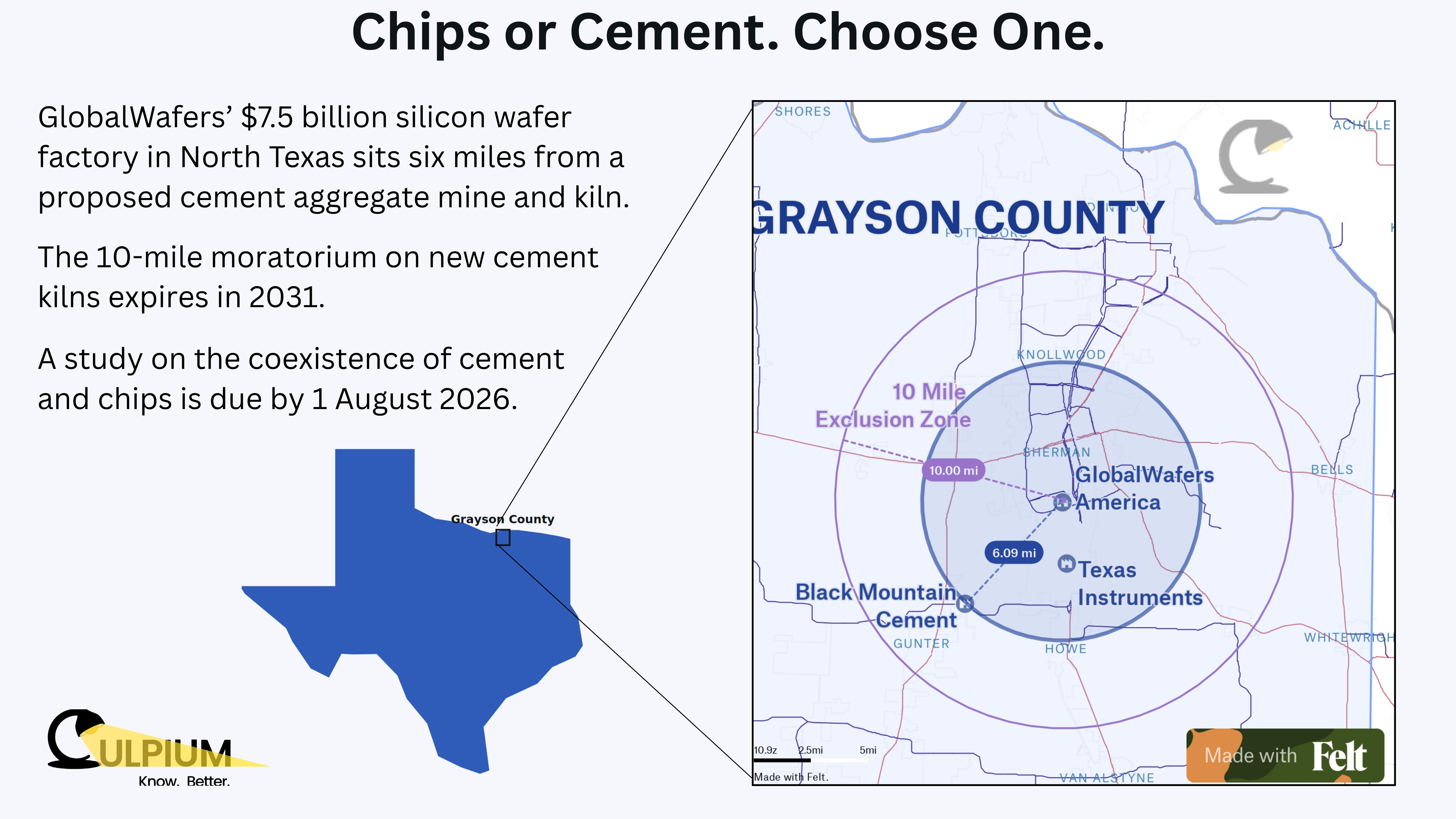
Soon after the plans took root, GlobalWafers hit a snag. A consortium of investors had bought land around six miles away with the plan to develop a cement aggregate plant. This project, called Black Mountain, would mine the local limestone by blasting the ground with explosives, digging up the rock, then pulverizing it into powder. The resultant mix would then be fed into a kiln where it’s baked into what we know as cement.
Silicon wafers are the very start of the chipmaking process. Silicon is chosen because it can be both an electrical conductor or an insulator depending on which chemicals are applied to it — hence the term semi-conductor.
But for the wafer to have the uniform electrical properties required to make electronic chips, it must be formed as a perfect lattice structure. This is done through what’s known as the Czochralski method: A single crystal — the seed crystal — is dipped into a crucible of molten silicon. It’s then slowly drawn upwards over a period of days to form a cylindrical ingot which then gets sliced into wafers. It must be perfect, down to the molecular level. Any seams — grain boundaries — could impact the chips built on top.
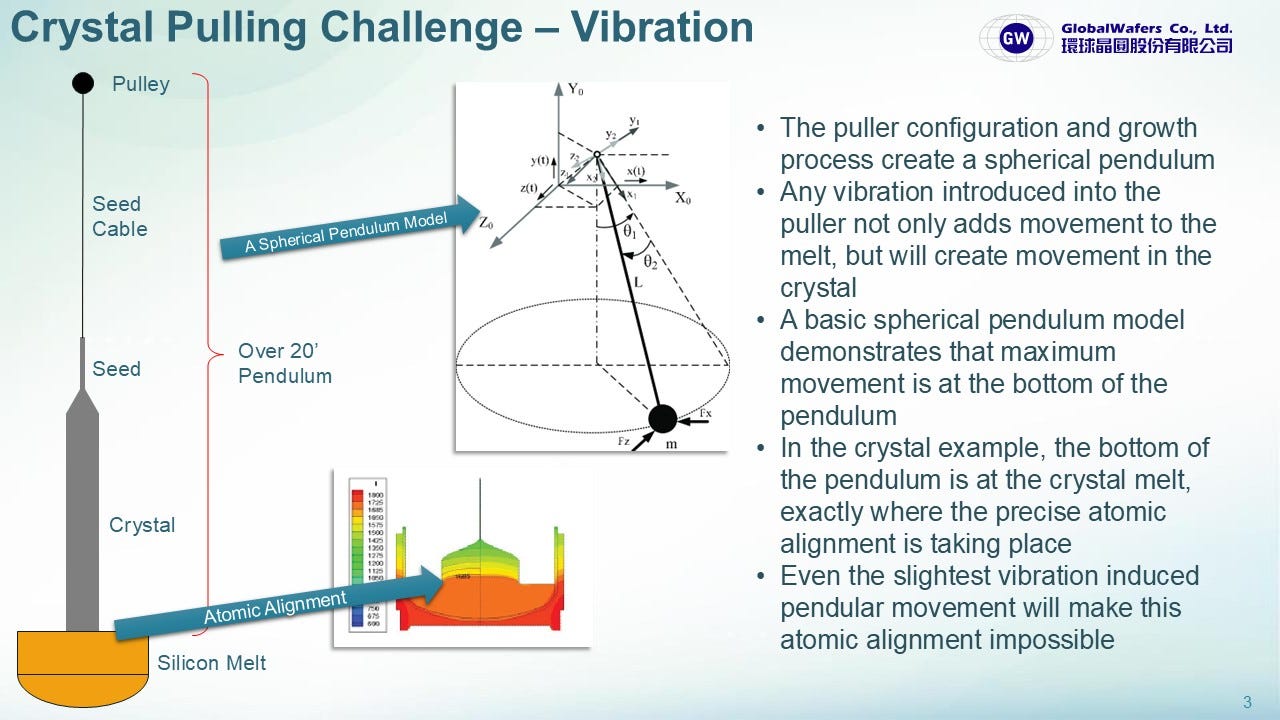
To achieve this, the environment must be dead still and squeaky clean because even the smallest amount of vibration or dust could ruin the entire process.
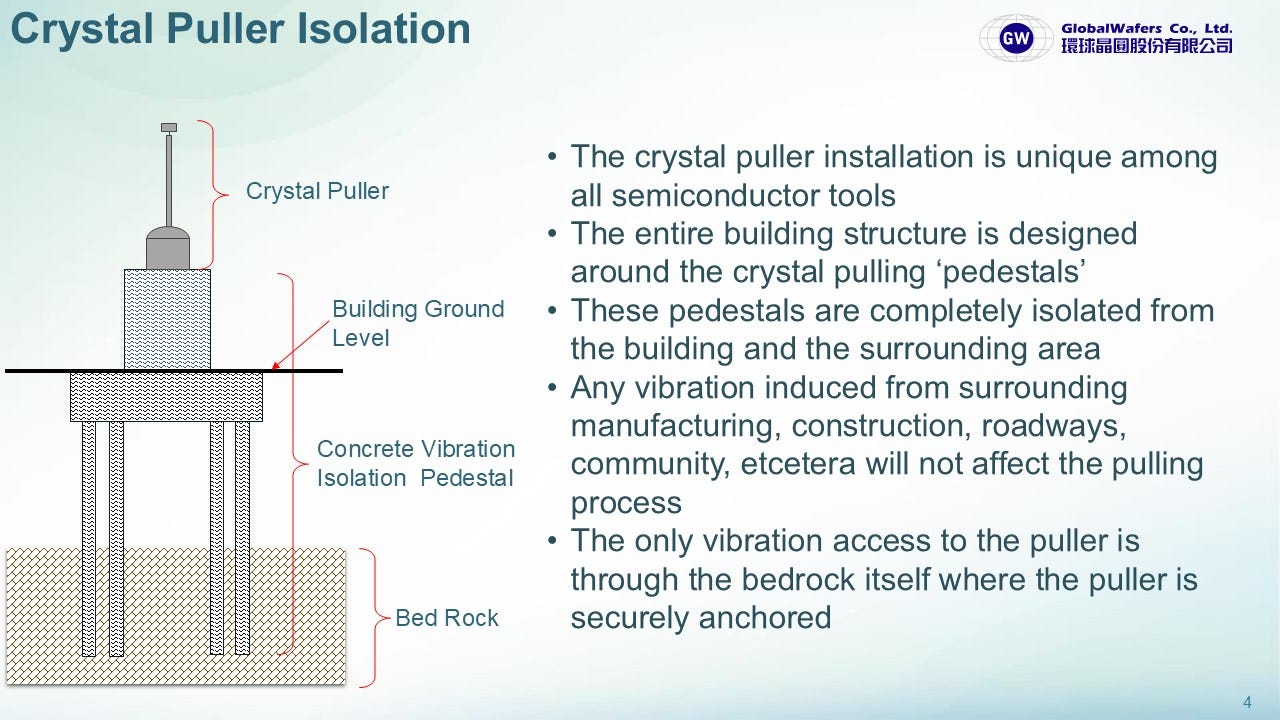
To ensure this stability, foundry constructors dig deep into the ground to find a firm, immovable foundation upon which to anchor the ingot-making equipment. That way, the process isn’t disturbed when rumbling trucks, nearby construction noise, or even strong winds shake the shallow layers of dirt. So while the factory shell and facilities can sit on the topsoil, the manufacturing tools need to be fastened to the stable bedrock below.
But when the Black Mountain project appeared on her radar, GlobalWafers Chairman Doris Hsu knew she had a problem.
“We’re on the same bedrock,“ Hsu told me in an interview recently. Mining the ground with explosives six miles away would shake the same rock upon which GlobalWafers had secured its $3.5 billion factory, and likely kick up enough fine dust and particles to contaminate the ingot-making process.
“One is the vibration, the second one is particles,” Hsu told me recently, outlining her concerns. “We care about both. Both are critical, both could kill us.”
Then the lobbying really kicked in.
GlobalWafers and Doris Hsu weren’t the only ones worried about a cement kiln built in their North Texas region of Grayson County. Local communities, environmental groups and even a local pastor were against the project.
“We care about both. Both are critical, both could kill us”
— GlobalWafers Chairman Doris Hsu
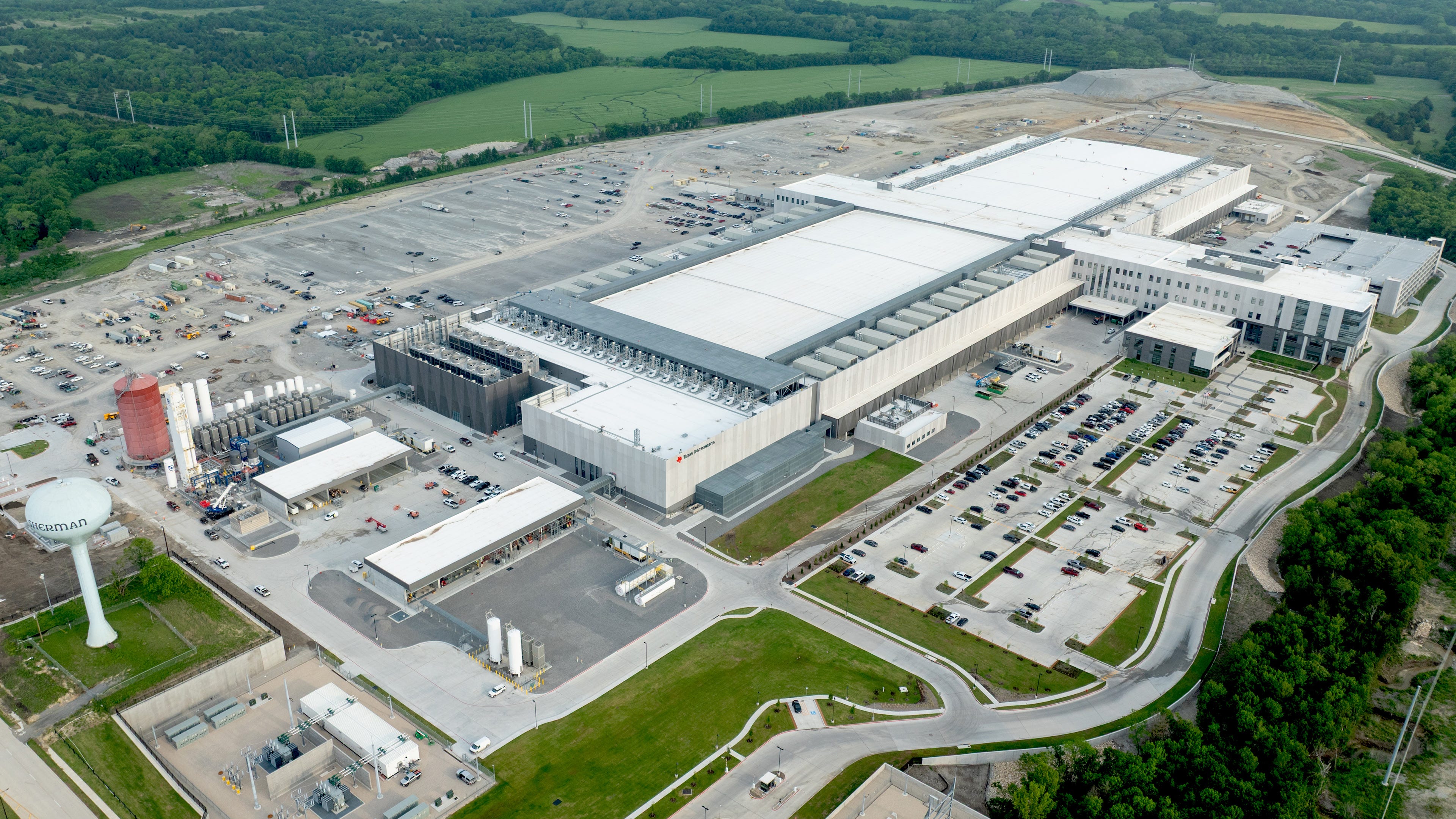
But with $3.5 billion, and soon $7.5 billion, on the line GlobalWafers had more at stake than most. Texas Instruments plans to invest $40 billion over four fabs in Sherman, so it arguably has the most to lose from any interruption, yet the US chipmaker has remained largely silent. Semiconductor manufacturers are already accustomed to attenuating ground vibrations and may be more resilient against blasting of the same bedrock.
Texas’ Light Touch
The challenge for GlobalWafers America (GWA), community leaders, and that local pastor is that what makes Texas such a great place to invest also makes it a tough place to halt a project once it’s underway. Compared to say, California, Texas has a very light-touch when it comes to regulation. And for Black Mountain opponents there were few legal channels through which a cement kiln could be stopped. Except for the dust.
The significant amounts of particles kicked up by a cement mine and kiln — they’re almost always located next to each other — means any proposal must first get approval from the Texas Commission on Environmental Quality (TCEQ). So instead of appealing to any sense of community justice or plain old NIMBYism, opponents played the environment card. The potential for air pollution warranted the Black Mountain project being shelved, they argued.
Among those allied with GWA and friends was Texas Lieutenant Governor Dan Patrick.
“I ask you to immediately pause the permitting processes for all permanent cement production plants statewide until the legislature can weigh in,” Patrick wrote to TCEQ Chairman Jon Niermann in April 2024. “Under no circumstance should this permit be expedited.”
By February 2025, Representative Brian Birdwell introduced SB1758, a bill so finely tuned for a specific purpose that I am going to call it the GlobalWafers Act.
The bill specifically bans TCEQ from issuing a permit to any new cement kiln that has an aggregate production facility within 10 miles of “a semiconductor wafer manufacturing facility that begins commercial operation after January 1, 2025, and before December 31, 2025.”
GlobalWafer’s new Sherman plant is the only one which falls in this category, and Black Mountain Cement is the only project planned within that 10 mile radius. Without naming either company, the Texas legislature sought to halt one in favor of the other.
Curiously, the bill included a grandfather clause exempting any aggregate facility from financial damages if it was already operating in the vicinity before the semiconductor-wafer plant. That, however, was a red herring. No such factory exists.
“Under no circumstance should this permit be expedited.”
—Texas Lieutenant Governor Dan Patrick.
With the Lieutenant Governor on board, and the bill introduced to the legislature, all that was left was for proponents to get it over the line and into the hands of Governor Greg Abbott for his signature.
Manufacturing Discontent
While there no doubt was a lot of local opposition to Black Mountain, and hence backing for SB1758, the groundswell support for the GlobalWafers Act may be less than it appears. In fact, there’s evidence that much of the submissions made to the legislature as part of the public-comment process were engineered rather than organic.
For example, the phrase “for the protection of our local and state economy” or similar terminology appeared in almost 40 of the 88 comments received by the legislature. And curiously, the exact sentence “I support SB1758 for the protection of our local and state economy, needed growth in the technology field, and for the protection of our national security that the domestic semi conductor sector provides” appears 18 times.
Brad Johnson at The Texan has a great rundown on the legislative fight for SB1758. Please click, read and support local news outlets.
Nevertheless, the lobbying worked and the bill passed both chambers and was sent to Governor Abbott. Who ignored it. Instead, it became law after waiting in his hands for the requisite 20 days.
But SB1758 is only a temporary victory. The moratorium expires in September 2031. For GlobalWafers, the uncertainty continues until a final determination can be made by the people of Texas and their governors.
Further Research
The next step in the process comes in August. Written into the GlobalWafers Act is a requirement that the Bureau of Economic Geology of The University of Texas at Austin conduct research to analyze the impact of aggregate production and the “vibrational parameters necessary to ensure the successful operation of a semiconductor wafer manufacturing facility within 10 miles.” That team has spent the past year running experiments and blasting the earth to see whether a cement mine and a silicon-wafer factory can co-exist.
If they can’t, then a decision has to be made.
Black Mountain and its supporters make the argument that cement is an important component of a modern economy. Not just for industry, but for residential development and transport. North Texas, they contend, has a shortage of cement which could be a curb on everyone’s prosperity.
That Governor Abbott declined to sign off on the GlobalWafers Act says something in itself. What’s more telling though is that, according to sources I spoke to, the Governor was not present when the project was announced in 2022, nor at the May 2025 grand opening. In fact, I am told Abbott has never visited GlobalWafers’ new facility in Sherman, Texas. The Governor did, however, meet Hsu during a July 2024 trip to Taiwan where he thanked her for the GlobalWafers investment.
While we mustn’t read too much into Abbott’s lack of presence, it is fair to conclude that the Governor of Texas is not a vocal supporter of one of the state’s largest and most consequential foreign investment projects. That lack of backing doesn’t bode well for GWA’s continued expansion given the continued uncertainty.
And Hsu needs the support. GlobalWafers’ current capacity, including the already-announced expansions, are sufficient to meet customer needs for the next few years.
But American companies, including Apple, Nvidia and AMD, are fighting over capacity at TSMC’s Arizona facility and are leaning on the Taiwanese company to make even more chips at the Phoenix site. And that’s not to mention President Trump’s continued pressure to bring more high-tech production to America.
An announcement on a third round of expansion at TSMC’s Arizona site is likely in coming months, my sources have told me. Expansion at Texas Instruments as well as more chips being made at US facilities run by Samsung, Intel, Micron and others opens up the possibility that more silicon wafers will be needed.
If that happens, GlobalWafers might need to invest even more. It could do so in Texas, or it could look elsewhere including back in Asia where most of the global wafer capacity is already based. Expansion overseas at the expense of the US would be counter to the administration’s goal of building technology resilience and boosting national security.
Chip-Blocking Trump
Hsu told me that she is also keen to expand in order to capture more of the global semiconductor wafer market. Adding another phase in Texas would mean another $4 billion or so of investment into Texas. But shelling out that kind of money could be risky if the cement issue isn’t resolved.
The legislature appears to be on GWA’s side, but not necessarily the state’s executive. Continued reticence by the State of Texas to come out with clear and unwavering support for GlobalWafers could be seen as Governor Abbott chip-blocking Trump and his MAGA agenda.
The University of Texas report is coming soon. It won’t settle the issue, but will include recommendations that can either be implemented or ignored. And at the very least, it will force the people and the leadership of Texas to make a decision. More chips, or more cement.
Thanks for reading.
More from Culpium


