

The World's Premier Chipmaker is Facing its Biggest Crisis Yet
[Opinion] Chairman and CEO CC Wei needs to make changes to employee relations, fast. His skyrocketing pay package doesn't much help matters.

Good Evening from Taipei,
TSMC’s CC Wei has negotiated with Donald Trump, delivered price rises to Tim Cook, and haggled over capacity allocation with Jensen Huang.
His hour-long talk with over 7,000 staff on Wednesday morning was far more crucial to the company’s long-term success than any other showdown the chipmaker’s Chairman and CEO is ever likely to face.
Faced with growing discontent over what many see as an unfair tweak to their compensation schedules, Wei canceled a business trip and at 5:30pm Tuesday night announced an impromptu townhall for 10am the next day. The event was in-office only — streamed to company auditoriums and meeting rooms — and booked out within 10 minutes, sources told me. Those who missed a slot could not dial in, I was told, a sign of the company’s paranoia about leaks.
TSMC pays out 12.5% of an employee’s annual bonus each quarter, with the final 50% delivered in July the following year. This quarter the company trimmed its payout while maintaining that full-year bonuses would still be higher than the prior year.
Tune in to this week’s Supply-Chained with Tim Culpan (Culpium) & Jon Y (Asianometry).
ASML: Riding the AI Wave, but Crushed by its Own Success
As Wei explained it, company profit is shared across three key categories: shareholders, employees, and ESG.
The reason for this adjustment is so the company could allocate “an even larger share of our earnings towards initiatives that foster social sustainability in order to give back to Taiwan.” In other words, more for ESG and less for staff.
The company’s explanation is staggering, confusing and not at all appeasing for thousands of the company’s 91,000 employees. Many have taken to bulletin boards and social media to express their frustration, anonymously, over what was seen as both a lack of gratitude and a measure of backsliding.
What’s particularly galling to many staff is that Wei’s own total compensation ballooned last year to $78 million — stated as NT$2.4 billion. Some employees whom I spoke with were flabbergasted when told of the CEO’s total compensation, which only came to light buried in the pages of its 2025 annual report which was published recently. They knew it was big but didn’t know it was that big. A small fraction of that figure comes from his salary, with the bulk coming from bonuses and allowances tied to performance, as well as profit sharing.
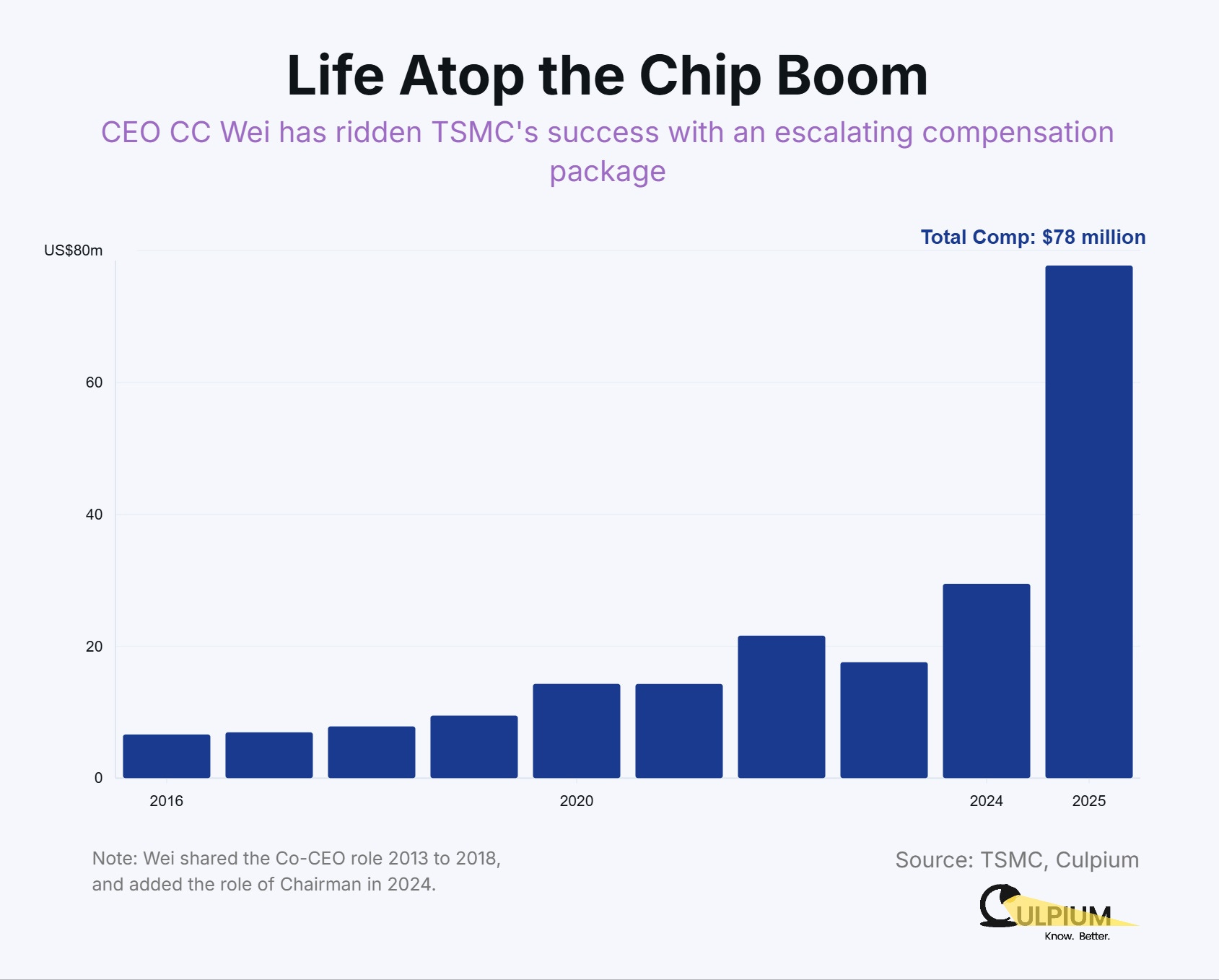
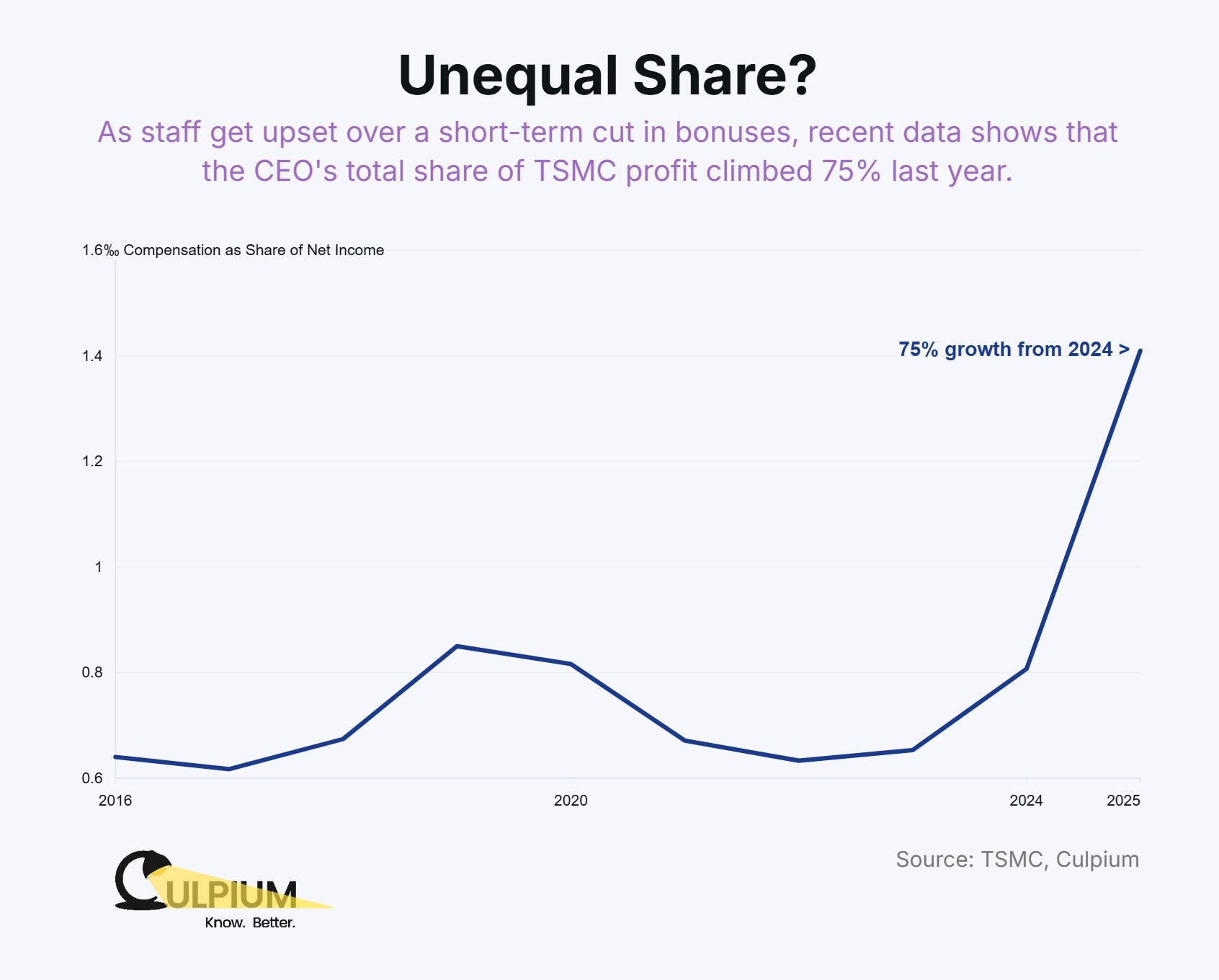
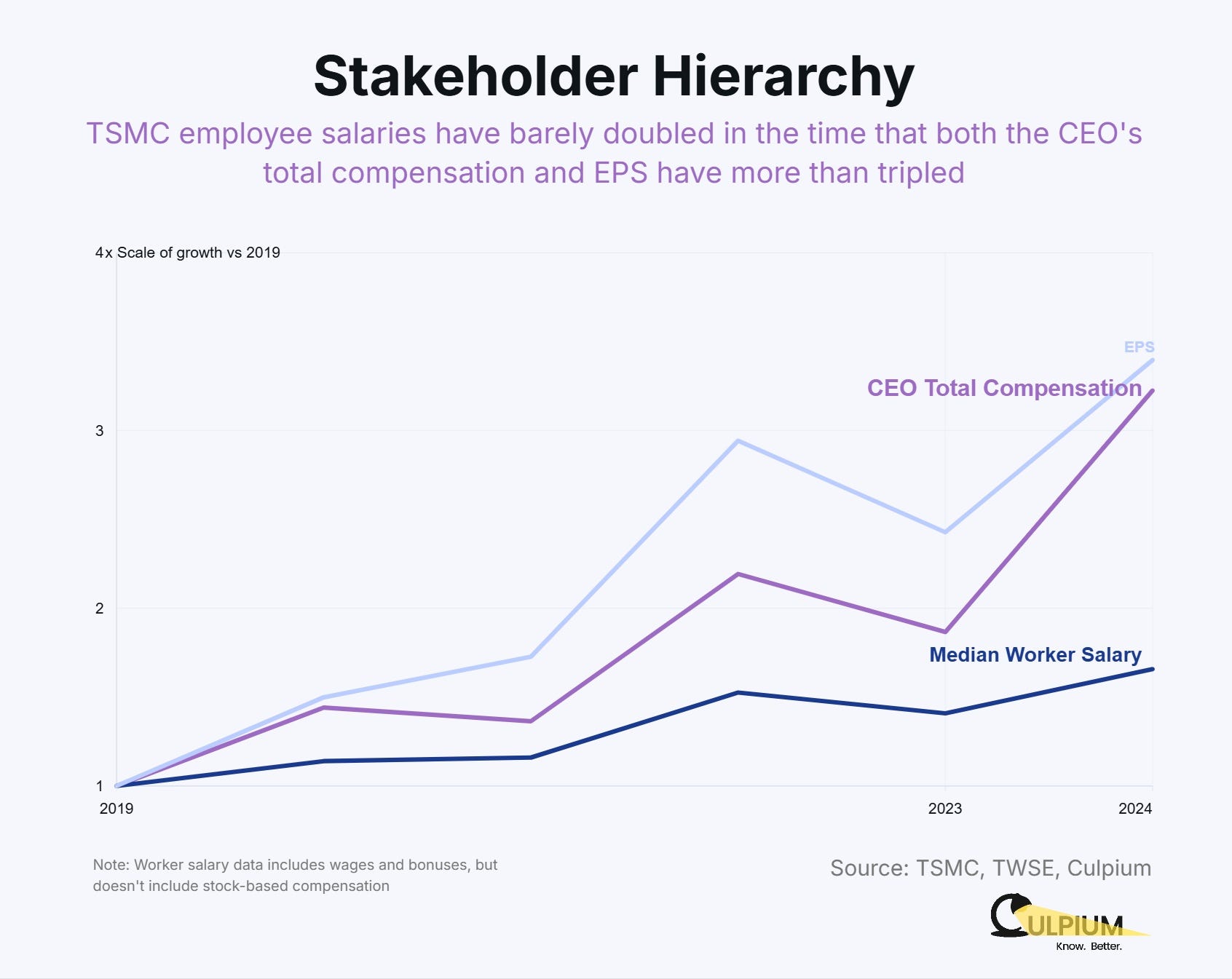
But beyond the actual figure, Wei’s total compensation as a share of net income climbed 75% in 2025. Likewise, his compensation has outpaced median employee salaries in recent years, according to Culpium calculations based on data in TSMC’s annual report and information filed to the Taiwan Stock Exchange.
In most Western countries, such large executive compensation packages are par for the course. In Taiwan, however, there’s an expectation that a modicum of egalitarianism be maintained between management and the rank and file.
Asked about his salary during Wednesday’s meeting, Wei punted and explained that his package is decided by the board, I am told. He also downplayed the prospect of a Samsung-style employee union, suggesting they’re more trouble for workers than they may be worth.
The issue is that many employees feel they’ve been working brutal hours to help expand capacity and churn out the world’s most high-tech chips amid a historic boom in demand driven by AI. It’s the staff, they reason, who should be getting the spoils and not some vague notion the company has about fostering “social sustainability.”
We would like to extend our sincere appreciation to all colleagues for their invaluable contributions. As the company continues to grow, we are highly confident that the full-year growth percentage of our employee profit sharing (based on performance evaluation) will surpass that of last year. We also believe that, with the company's sustained future growth, our profit sharing will continue to increase. — TSMC Statement, 25 May 2026.
As this issue started to boil over, a number of employees reached out to me directly to vent their frustration, share their take, and ask if I had further information. That a journalist was seen as a more reliable source than their own company speaks volumes. The tamest comments I got framed the saga as merely a problem of poor communication rather than corporate malice. Others were not so kind and noted that Wei himself enjoyed record compensation last year while revenue, profit and market cap have climbed to record highs.
These issues put together are not a good look for Wei.
In Wednesday’s townhall, he didn’t back down on TSMC’s decision to amend the payout plan. Instead, he spent time explaining the policy and then taking questions on dozens of topics which started to veer far away from the original agenda, my sources tell me.
This event may have succeeded in fending off a revolt, for now, but the lessons from Samsung show that management should not take employee goodwill for granted.
Wei, who’s been in the role for eight years, will surely know that the last time a CEO of TSMC messed up employee relations he lost his job. Wei is in his current position as a direct result of his predecessor, Rick Tsai committing an unforgiveable sin.
Back in 2009, in the dark days of the global financial crisis, Tsai implemented unprecedented layoffs. Even though the scale of the cuts — at 5% of staff — was small by Western standards, the move was widely seen as a breach of an unwritten covenant: never lay off employees.
Within months of those layoffs founder Morris Chang — who held onto the Chairmanship after handing the CEO role to Tsai — apologized for the cuts and said TSMC would welcome back all those who were laid off. Soon after, Tsai himself was booted though he stayed at the company for a few more years in a lesser role. Chang retook the CEO role and then groomed two replacements: Wei and Mark Liu, who both shared the Co-CEO role until Chang’s later retirement.
Wei has climbed through the ranks and has first-hand understanding that for a knowledge-based company at the leading edge of technology, employees are the primary reason TSMC has defeated Intel, Samsung, UMC and numerous others. And they’re also responsible for continuously keeping Apple, Nvidia, AMD and hundreds more addicted to the Hsinchu-based giant.
“Human capital is TSMC’s most treasured asset. The Company strives to provide employees with meaningful work, continuous learning, a healthy and inclusive workplace, and high-quality compensation and benefits” — TSMC 2025 Annual Report.
But touchy-feely measures like staff gymnasiums, exclusive company-branded merch, an annual sports day, and the warm glow of being a good corporate citizen do not make up for the one reason workers at every company turn up each morning: the money.
And Wei himself knows a little about money. His own compensation has climbed 10-fold over the past decade. It would be hard to argue that he does not deserve the fat pay package, but it would be impossible to argue that his staff don’t deserve more, too.
And now is not the time to turn his back on an employee-first culture or pinch pennies.
A widening global rollout, including a record pace of expansion in Taiwan, coupled with new fabs in Arizona, Japan and Germany will raise the need for staff. And finding the right staff isn’t easy. More than half its headcount has at least a Master’s degree. Concurrent booms among memory-chip makers, a resurgence at Intel, and more global tech companies getting into the chip-design business is increasing competition for a limited pool of talent.
Its troubles in Arizona highlight the issue of attracting and keeping talent. TSMC is facing a class-action lawsuit claiming discrimination, while a rising number of staff are quitting to return to their old jobs at US companies like Intel, Micron and Texas Instruments. Then there’s China, where dozens of state-backed companies are eager to write fat checks to any TSMC engineer willing to cross the Taiwan Strait.
TSMC is rightly proud of its ESG policies, which include buying renewable energy, recycling water, and giving to charity. But in attempting to “foster social stability,” Chairman and CEO CC Wei may be forgetting the most important policy of all: If you don’t keep your staff happy, someone else will.
Thanks for reading.


Very interesting. Thank you very much Tim. As always you share great insights and your title nails it. People are the most important factor for the success of a company.
Money solves most problems that money created. Raise prices for wafers MORE. Expand capacity so you don't throw a lifeline to intel and samsung and have the fabless guys bid on that extra capacity. Then pay them (employees) what you owe them. From what I understand about TSM culture (harder conditions than koreans), they deserve it.