

Apple Doubles MacBook Neo Production, Orders Fresh Batch of Chips
[Exclusive] After facing a dilemma, Apple opted for a fresh run of SoCs to be made at TSMC in order to meet strong demand

Good Evening from Taipei,
Apple has doubled its MacBook Neo production plans after the laptop’s runaway success, my sources tell me.
Last month Culpium broke news that Neo sales were doing better than Apple had expected, pushing the company into a tough dilemma. Demand heavily outstripped supply, forcing the company to quickly make a decision about the product’s near-term future, Culpium wrote at the time.
Apple is in talks with suppliers to handle a massive dilemma posed by sales of its MacBook Neo that have surpassed expectations, I am told. The question they must answer, and soon, is whether to boost production of the hit laptop, or let their inventory of parts run out, my sources tell me — Culpium, 7 April 2026.

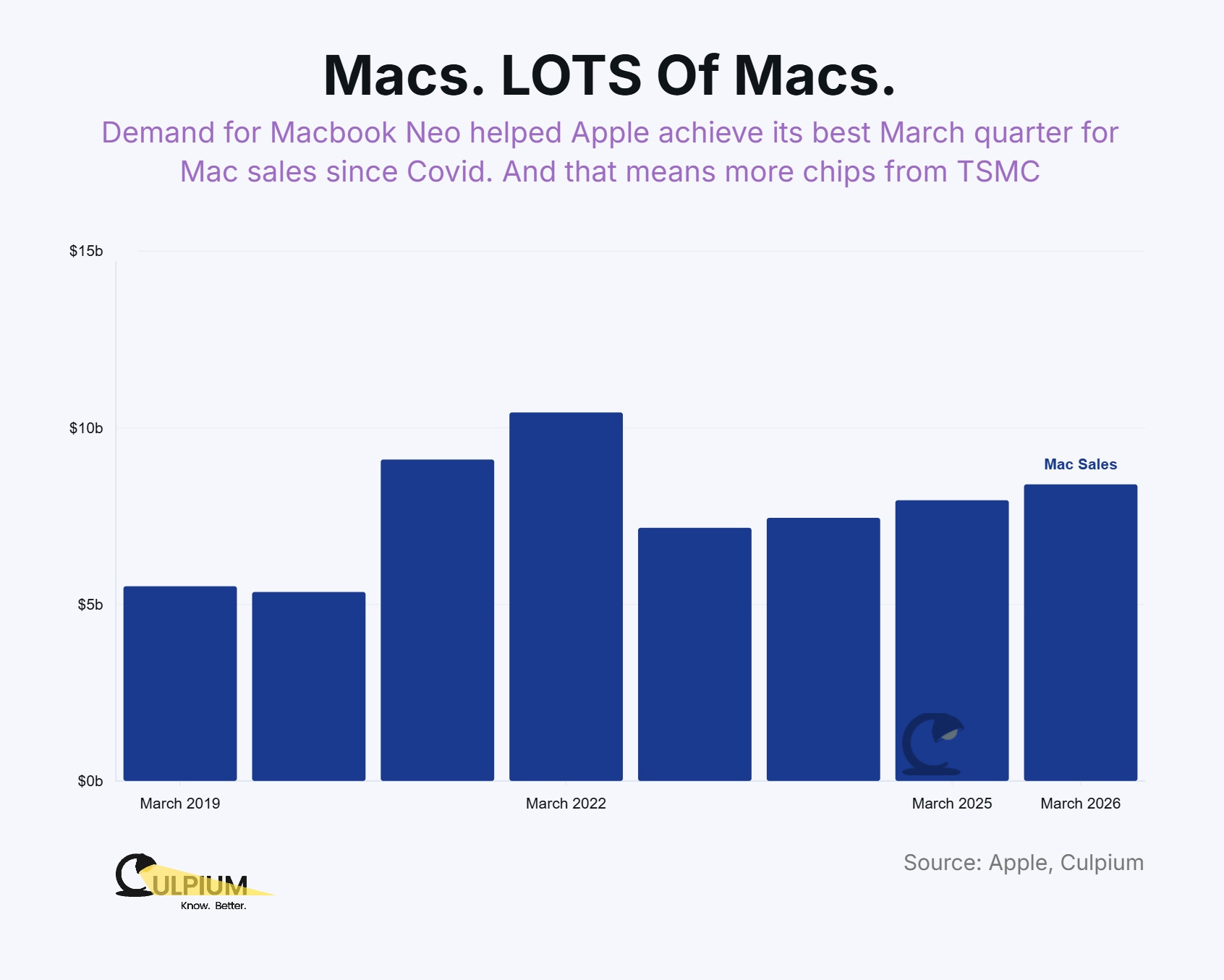
Its earnings report last week brought this issue to life, with Neo driving Apple’s best fiscal second-quarter for Mac revenue since the Covid pandemic.
“Right now we’re supply-constrained on the MacBook Neo,” CEO Tim Cook said in the company’s April 30 investor conference call. “We were very bullish on the product before announcing it, but we under-called the level of enthusiasm that would be with it.”
Tune in to this week’s Supply-Chained with Tim Culpan (Culpium) & Jon Y (Asianometry).
Episode 3: ARM Might be Swallowing its Own Poison Pill
MacBook Neo is now seen as a legitimate alternative to Chromebooks, powered by Google’s ChromeOS, as well as low-end Windows laptops. The cheapest member of the MacBook series is likely to lure more companies and students into adopting the MacOS ecosystem, broadening Apple’s user base.
We’re swapping out Chromebooks for Neos over the next few weeks
by u/shinyshirtlesssulu in MacbookNeo
This unprecedented popularity left Apple with an important decision to make: It could sell out of the Neo, thus forgoing sales but preserving profit margins. Or order up a new batch and face a severe cut in gross margins amid escalating DRAM prices and a higher cost-base for the core processor.
Apple recently made its decision and opted to put more units of the Neo in customer hands.
As a result, it’s now asking suppliers to prepare capacity for 10 million units of the debut version of the Neo, up from an initial estimate of 5 million to 6 million, my sources tell me. Delivery times for the laptop have ballooned to as much as four weeks as Taiwan’s Quanta and Foxconn rush to fill orders from factories in Vietnam and China.

This renewed commitment to meeting demand means Apple must also ask TSMC for a hot lot of A18 Pro chips, the same processor used in the iPhone 16 Pro. The system-on-chip is made using TSMC’s N3E process, with the initial production run underway at least two years ago.
However, the chips used in the Neo are actually downbinned versions of the one used in the iPhone, meaning some parts of the die were considered defective or unable to run at its full design spec.
In keeping with industry practice, instead of scrapping these “less-than-perfect” chips, Apple turned off the defect parts and repurposed it for another product. As Ben Thompson of Stratechery wrote at the time, this downbin strategy means the SoCs in the Neo are effectively “free chips.”
Jon and I discussed binning at length in a recent episode of Supply-Chained.
The iPhone 16 Pro’s processor has six GPUs, whereas the MacBook Neo’s has only five — it’s the same chip, but with one GPU core turned off.
With a fresh batch of A18 Pro SoCs, most of the new processors for the Neo will actually be top-tier and only some would fall into the downbin category. This means that in most cases the six GPUs would be fully functional. Apple is likely to deal with the disparity by simply switching off one of the GPUs through software.
The other issue Apple must face is the higher price. While TSMC may forego massive price premiums for a hot-lot run, the SoC will still be more expensive than the first batch because they’ll mostly be top-tier rather than downbin versions. In addition, DRAM prices have escalated since the initial production run, driving the Neo’s bill of materials much higher.
Apple currently offers the Neo in 256GB ($599) and 512GB ($699) versions with four colors apiece. A month ago I suggested that to deal with the higher cost and lower margins of a new batch, Apple may kill the cheaper version and only offer the 512GB variant. It recently followed that strategy with the Mac Mini, pulling the $599 256GB model from sale leaving only the $799 512GB version available.
Alternatively, Apple might add some new colors to the Neo lineup to soften the impact of higher prices and boost enthusiasm for the device.
Thanks for reading.


