

Cook's True Legacy is Little Known and Quite Misunderstood
[Opinion] Call him woke. Call him a hypocrite. But don't deny Tim Cook's impact as a changemaker.

Good Evening from Taipei,
Walter Isaacson’s 2011 biography of Steve Jobs made almost no mention of China, nor Apple’s manufacturing partners. Should a similar tome be written about Tim Cook, I hope this egregious omission won’t be repeated.
Cook’s re-engineering of Apple started in 1998, more than a decade before he took the CEO mantle from Jobs. He had an impact almost immediately, but there are many misunderstandings about what Cook actually changed about Apple’s operating model.
Introducing Supply Chained
A new podcast hosted by Tim Culpan of Culpium (me) and Jon of Asianometry.
We explore the depth & history of supply chains to unveil how today’s technology is made. And what comes next.
We hope you’ll join us.
As senior VP of worldwide operations, Cook was not the man who brought outsource manufacturing to Apple. Nor was he the man who brought China into the company’s supply chain. Both moves predated both Cook, and even Steve Jobs’ return to the company he founded.
Ireland, Singapore, Japan, and South Korea had been sources of Apple product and components since at least the early 1990s, both for inhouse production and also external component supply.
Outsource contract manufacturing was already well underway, not from Asia but via American companies such as SCI Systems and Solectron who pioneered the model. Foxconn founder Terry Gou, at the encouragement of a senior Apple executive, embraced that electronic manufacturing services (EMS) framework.
Seeing the future, Gou slowly oriented his Taiwanese empire away from mere plastics and mechanical components — like metal PC cases — and dove deep into integrated vertical manufacturing. Dell and Compaq had signed on as clients well before Apple came along.
In other words, outsourcing to Asia was underway by the time Cook arrived. It was already in Apple’s future. Cook embraced it.
Yet, Cook and his team brought important operational innovations that remain significant a quarter of a century later. Among them, Apple went deeper into the little-understood but hugely impactful practice of equipment consignment. I wrote about this 16 years ago when I profiled Gou and Foxconn for Bloomberg Businesweek. Patrick McGee covered it in his recent book “Apple in China.”
Made to Measure
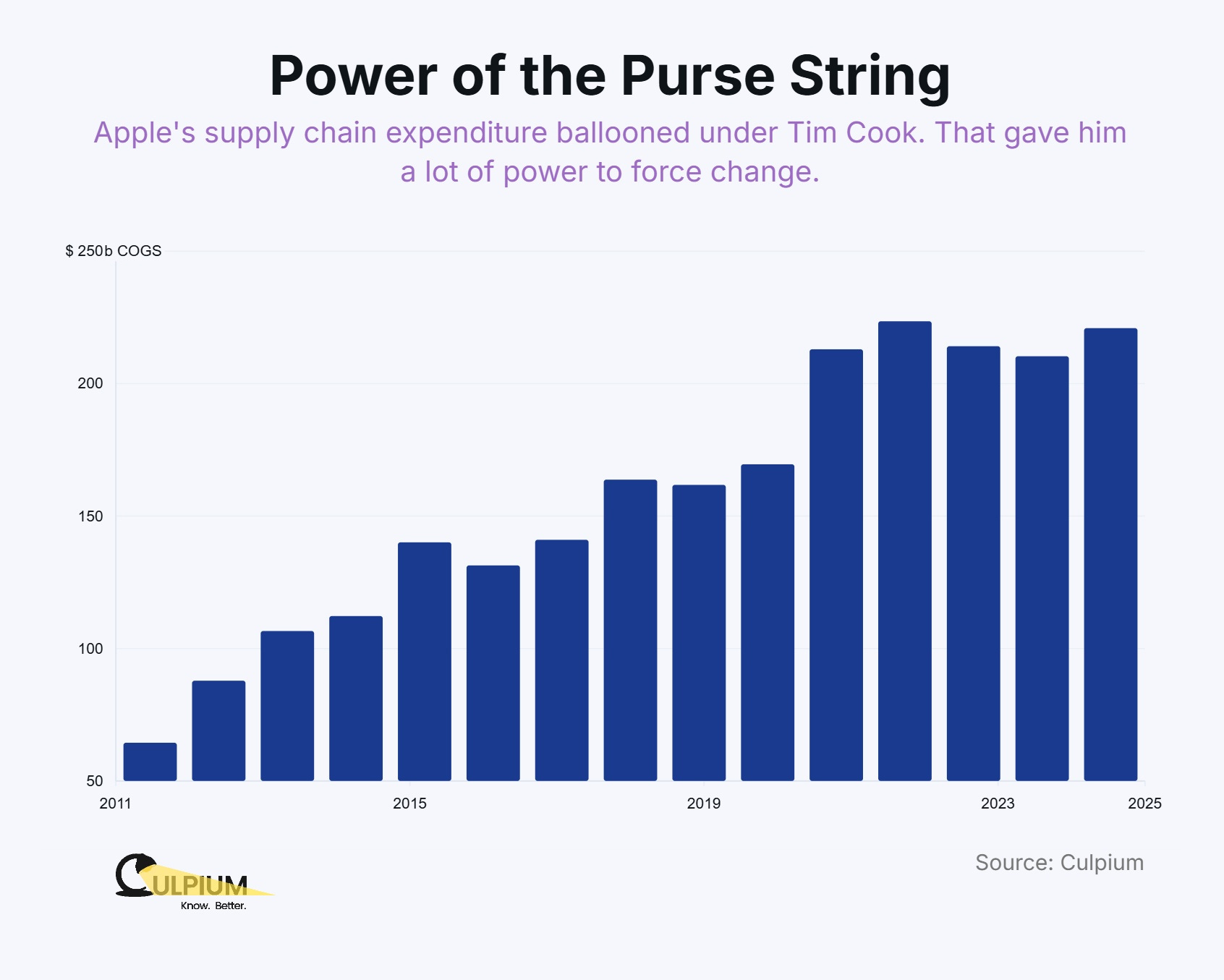
Apple often pushed the boundaries of what was physically possible, and that usually meant the need to use new and unique equipment. Its suppliers rarely had the funds to buy such expensive kit, so Apple would write the check with a very specific stipulation: it could only be used to make Apple’s products. This allowed the manufacturer to get the tooling needed to satisfy Apple’s niche requirements, but also locked up factory capacity and resources. Cupertino still uses this strategy today.
There are numerous examples of Apple building unusual relationships with its supply chain, down to insisting that an off-the-shelf component be tweaked just for them.
But beyond the minutiae of manufacturing, Tim Cook’s Apple changed the world in bigger ways.
In my opinion, three foreigners have done more for the development of the modern PRC than anyone else. The first is Henry Kissinger (iykyk). The second is Terry Gou. And Tim Cook is the third.
Gou’s impact was already apparent in the mid-1990s as he connected foreign clients with Chinese workers in the former farmlands of Shenzhen. He was the ultimate salesman, middleman, and logistics chief. Cook signed on.
As Apple factories around the world were shuttered, and contracts started disappearing from Japanese and Korean factories, Cook went all-in on China. By the early 2000s, Foxconn was China’s biggest exporter and a big chunk of that was for Apple.
By 2010, Apple was Foxconn’s single-largest customer. Through its partnership with mostly Taiwanese factories in China, Apple fed, trained, and nurtured more Chinese people than any non-government enterprise on the planet. The continuous income stream Apple provided became an important foundation for the technology-manufacturing hub that China enjoys today.
Cook’s Compromise
But it also made Apple overly reliant on a single country, one that is increasingly at odds with the values of human rights, privacy, and freedom which Apple claims to embrace. To keep China as both a supplier and buyer of its goods, Tim Cook made compromises.
Apple has booted products from its App Store used by pro-democracy movements and bolted shut technological loopholes which allowed people to communicate directly rather than via restricted communications networks. And while industry peers slowly and quietly reduced their China footprint, Apple hung on.
For each of these decisions, the buck stopped at Tim Cook. Such choices have attracted accusations that Apple is a hypocrite, or even downright evil. Maybe, but that’s also a little simplistic.
Consider its 2012 decision to join the Fair Labor Association, an industry group that had counted Nike among its members. There’s no doubt this decision was prompted by the spate of suicides at Foxconn two years prior. Yet, having spent more time in and around Foxconn campuses than most, I can tell you that conditions there are far better than many were led to believe. I can also tell you that trying to paint a more nuanced picture quickly attracts allegations of being an Apple apologist.
Whatever the supposed sins of Apple and Foxconn, the truth is that both companies — and the rest of the iPhone-maker’s suppliers — were quick to embrace change. To seek to do better. That came from Cook.
He backed up his directive for better conditions with the money needed to do so. Foxconn doubled — then tripled — wages and passed the bill to Apple. I have not seen or heard anything to suggest Steve Jobs ever noticed, nor cared about suppliers or their workers. Cook visited regularly and genuinely seemed interested in their plight.
Planet Possible
The biggest impacts from Cook’s leadership span the globe. In 2013 he hired Lisa Jackson, the former head of the US Environmental Protection Agency. Jackson wasn’t brought on board as a marketing ploy or to tick a box, it was a recognition that Apple is truly serious about cleaning up the planet.
In today’s political climate, environmental initiatives are branded mere wokeness. But Apple’s long-term strategies in areas such as pollution control, use of sustainable materials, and connecting to renewable energy are bringing about real change. Because it has the money to pay for these costly measures, both directly and through funding its suppliers, the world now enjoys a cleaner planet than had Apple not even bothered.
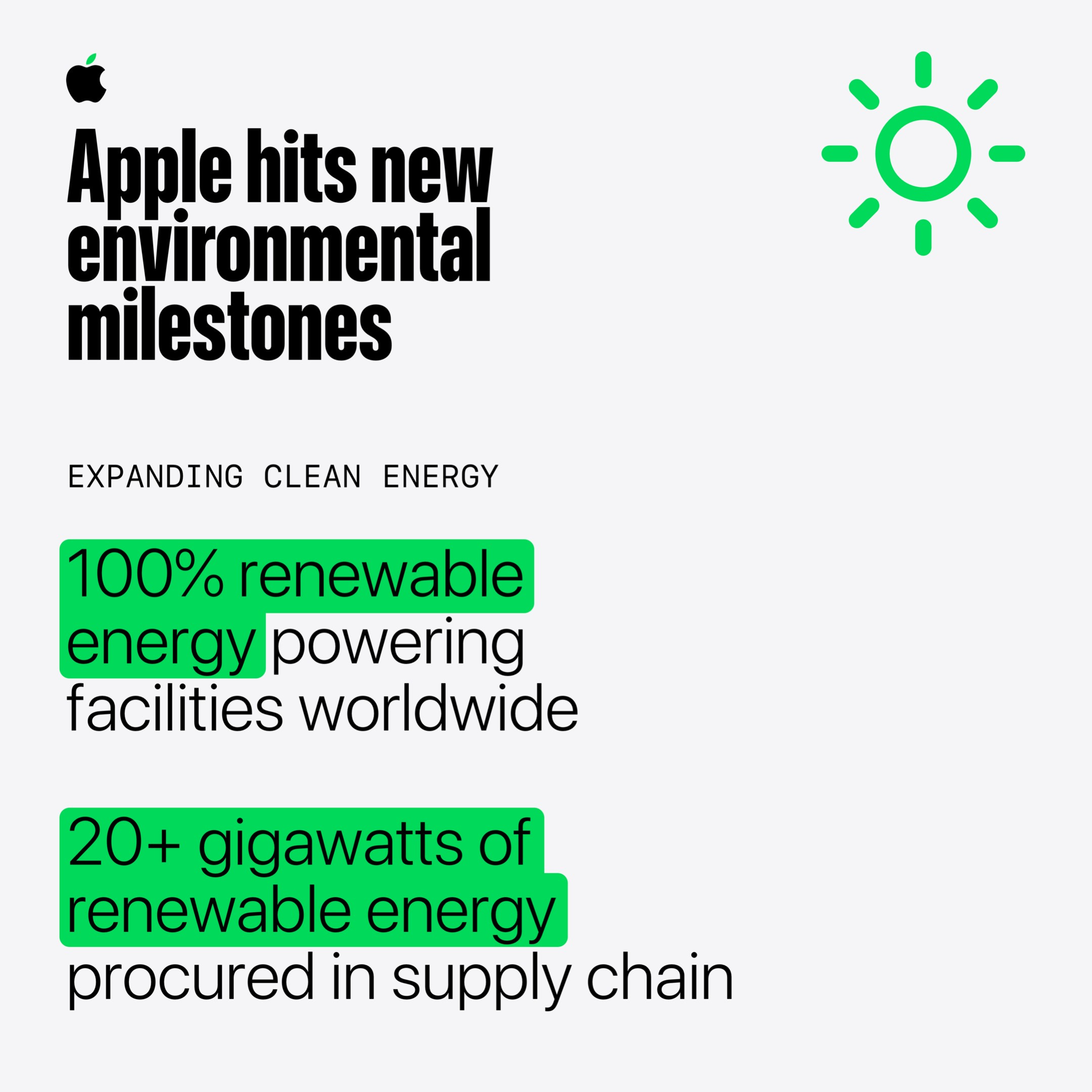
Apple’s massive spending power means companies can afford to invest in offshore windfarms and solar arrays, recycle commodity products and rare earths, and develop innovative chemicals and textiles. In a world where caring for others and the planet has been made to seem weak, solutions to protect the environment fell out of favor. But now, at a time when rare earths are hard to come by and energy security is of increasing concern, these strategies seem more relevant than ever.
The Ternus Take
John Ternus, who joined Apple just three years after Cook, looks set to embrace some of his predecessor’s philosophy. In a commencement speech to the graduating class of 2024 at his Almer mater, the University of Pennsylvania, he spoke of “a deep desire to do what we can to protect the environment.”
Yet, he also urged graduates to “build what interests you. Build what excites you. But above all else, build it in a way that aligns with your values.” Like Cook before him, Ternus’s values probably include labor rights and environmental protection. But let’s hope he also embraces human rights and freedom of speech for everyone, not just Apple’s Western hemisphere.
It was always understood that Cook would run Apple very differently to Steve Jobs. Now, upon his retirement, it’s abundantly clear that Tim Cook has indeed built Apple in his own image.
Thanks for reading.


Very well said. Thanks for this.