


Good Evening from Taipei,
Update: The first edition of CASCI is now live:

Last month I outlined the depth of the AI supply chain, and Taiwan’s unique role at the center of the action. I followed that piece by opening my playbook for tracking the manufacture and sale of AI compute infrastructure, and the components which go into them.
Numerous readers responded with enthusiasm. Many asked why I am not charging for Culpium (because I am dumb!?), and why I provided such a valuable inside-look for free. I appreciate that enthusiasm and support.
Next week, I will go one step further.
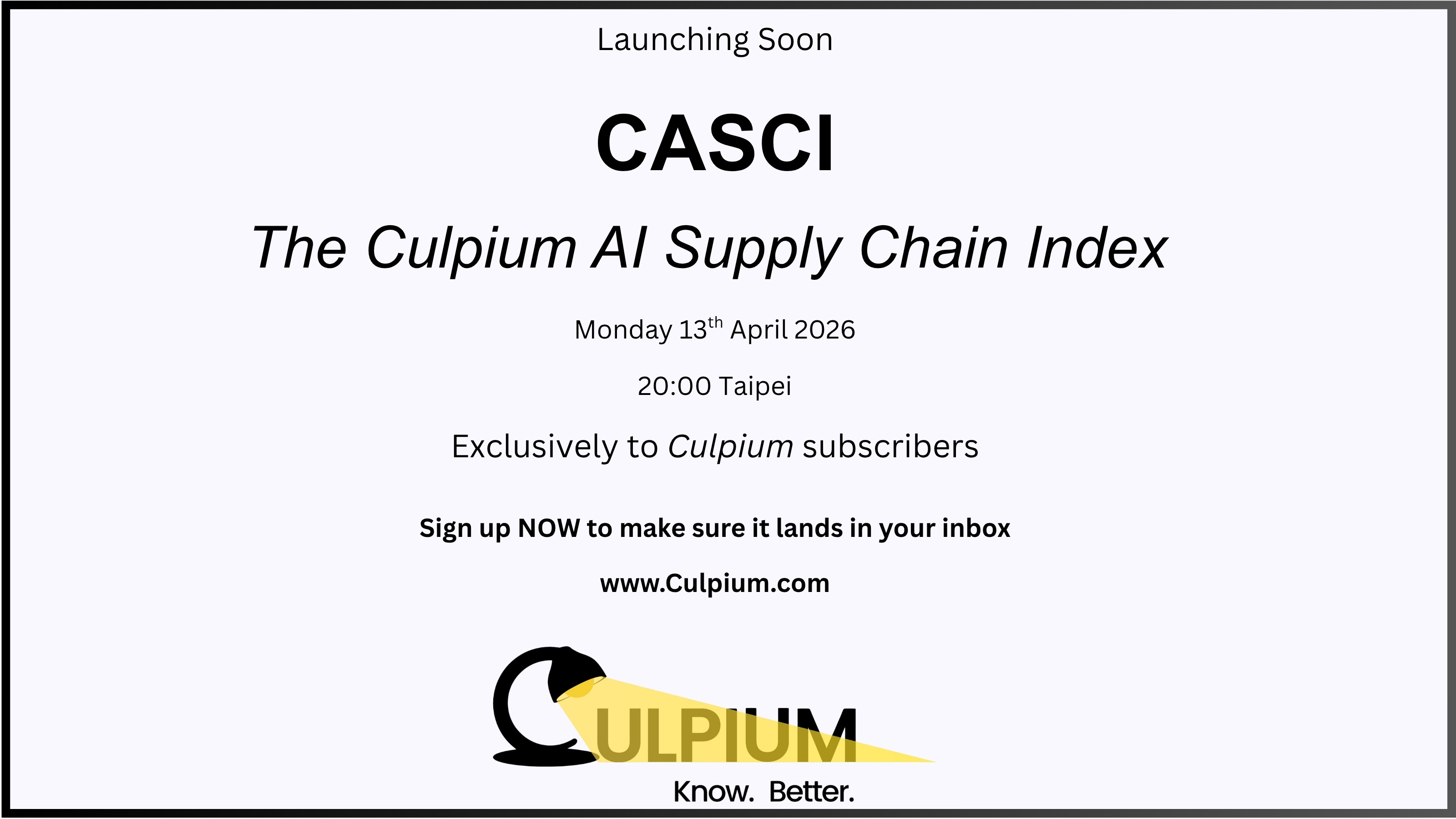
On Monday 13th April — at 20:00 Taipei, if you want to set your alarm — I’ll be publishing the first edition of the monthly Culpium AI Supply Chain Index — CASCI.
It’s not well known that my background is in economics and econometrics. My undergrad major was in economics and finance, and I even did an internship at Australia’s Department of Foreign Affairs and Trade where I analyzed Australia’s trade with Europe. I have never formally worked as an economist or statistician because journalism was always going to be my career path. But these analytical tools have been fundamental to the way I dig up ideas and chase down news, and it’s a key feature of Culpium.
CASCI (pr. Kass-key) is the product of many months of data compilation, analysis, and testing. The index has existed in rudimentary form for more than a decade — not for AI specifically, but for my own use to more broadly track the technology supply chain.
Now it’s time to share it with you.
CASCI is built on monthly revenue data released by more than 1,000 Taiwanese publicly listed companies. Many of these businesses are entirely unrelated to AI — bicycles, restaurants, textiles. But a crazy number do have their fingers in the AI pie. I spent an inordinate amount of time going through earnings statements, annual reports, IR calls, client announcements, and media reports to sort the key cast from the background extras.
A core goal of this research was to find those companies which get a significant amount of their revenue from AI and are themselves major players in their own slice of the AI market. The result is a basket of three-dozen companies across the supply chain — upstream, mid-stream, downstream, and capacity.
Almost the entire value chain has been captured. But there are some gaps. Taiwanese companies are not players in the DRAM space, nor are they major suppliers of semiconductor-manufacturing equipment. But thankfully, there are ways to fill these holes.
The contract-assembly business model includes components such as memory at the top line. Hon Hai’s revenue, for example, incorporates the cost of buying DRAM from SK Hynix. So, CASCI does not capture SK Hynix revenue but does include Hon Hai. There are also companies directly correlated to memory, such as those which make memory-controllers.
Capacity capex is similar. A collection of local firms, for example, help TSMC build its fabs and kit them out with utilities like HVAC and wiring. Another subset offer unique production and testing tools that are used in the fabrication and assembly process. They’re not ASML or Tokyo Electron, but they follow the same trends.
So, while there are important companies that are not captured by CASCI, I am confident that I have enough solid proxies to track the AI supply chain without them.
Then there’s the size and scale issue. Hon Hai and TSMC are such huge companies that a revenue or market-cap weighted index would be dominated just by them, meaning that important signals would be lost in the shadows of the giants. But equal-weighting a tiny supplier of circuit-boards alongside a behemoth that spends $50 billion a year wouldn’t make sense either.
So, I dove deep into peer-reviewed research to find the best, most-trusted, and most robust methodologies. This was a nergasmic experience, and it reminded me how much I enjoy the study of economics and its cousin discipline of econometrics. CASCI employs smoothing and weighting techniques already used in major statistical series compiled by the OECD, the US Federal Reserve, and other economic institutions.
The result is an index which aims to capture signals while minimizing noise — which, frankly, is the goal of any statistical measure.
CASCI is different to any other publicly available data release for a few reasons.
CASCI is real.
Closely-followed measures such as a Purchasing Managers’ Index (PMI), export orders, and manufacturing activity are based on sentiment surveys of people or samples of data from companies and factories. They’re generally quite robust and consistent, but they’re not built on a full set of numbers. CASCI is based on revenue, a real, complete and actual measure of what companies are doing (and selling).CASCI is fast.
By the time a company reports its quarterly revenue, two-thirds of the signal (the 1st two months of the quarter) is 30-60 days old, and the entire set is around 90 days old. Thanks to Taiwan’s monthly reporting requirements, including the mandate to file by the 10th of each month, CASCI provides the fastest signal possible. A sudden cut in orders or rush of shipments will show up long before quarterly earnings. Furthermore, you can pinpoint the timing of that action to within a few weeks, not months.CASCI is global.
Most robust measures of activity like PMI, exports, and even GDP are country-specific. Because Taiwanese companies must report all of their revenue, including that which comes from overseas factories, their data captures global signals. This is particularly crucial as supply chains fracture and move away from China. Servers built in Houston are captured by CASCI, chips fabbed in Arizona are captured by CASCI, motherboards assembled in Thailand are captured by CASCI.
Going forward, you can expect a monthly CASCI update. It’ll be a single number showing the strength and growth of the AI compute industry — bigger is better — along with a cycle-phase indicator approximating the current place within the broader timeline of the industry’s ebb and flow. I’ll then give you some analysis on the data, what it means, and the current state of play in the AI compute build out.
Companies are required to file by midnight on the 10th of each month — some report just a little later. Therefore, CASCI will come out at 20:00 Taipei the following day, except when these deadlines fall on a weekend or public holiday.
Oh, and it’s free (yeah, I’m dumb).
I hope you find CASCI interesting, insightful, and useful. Look out for the first edition next week.
Thanks for reading


Not dumb. Just very generous! Thank you.🙏
thanks sharing insight