

Steelmanning Trump's Backflip on Nvidia Sales to China
[Opinion] A look at the logic of selling AI chips to China. And why I still think it's flawed.

Good Evening from Taipei,
President Trump announced an about face on US restrictions on the export of select high-end Nvidia chips to China. The outcry from national security circles was swift and warranted. I believe it’s a mistake for Washington to allow such powerful digital weapons to be made available to its largest adversary.
Nevertheless, as an intellectual exercise I decided I’d take the opposite side of the debate. Ben Thompson constructed a steel-man argument in August by explaining why the US should take a stake in Intel. I disagree with that transaction but found his discussion at Stratechery to be quite enlightening. So, yes, I am copying Ben’s idea for this one.
Steelmanning is the act of taking a view, or opinion, or argument and constructing the strongest possible version of it. It is the opposite of strawmanning.
Jensen is starting to look like the new Elon, and clearly his bending of the president’s ear has had an impact. I was in the room when the Nvidia founder and CEO explained, in response to a media question, why restricting sales to China was a mistake. Since then, he’s used various permutations of the same argument across numerous platforms from a forum held by the influential Center for Strategic & International Studies to a 2.5-hour chat with the even more influential Joe Rogan.
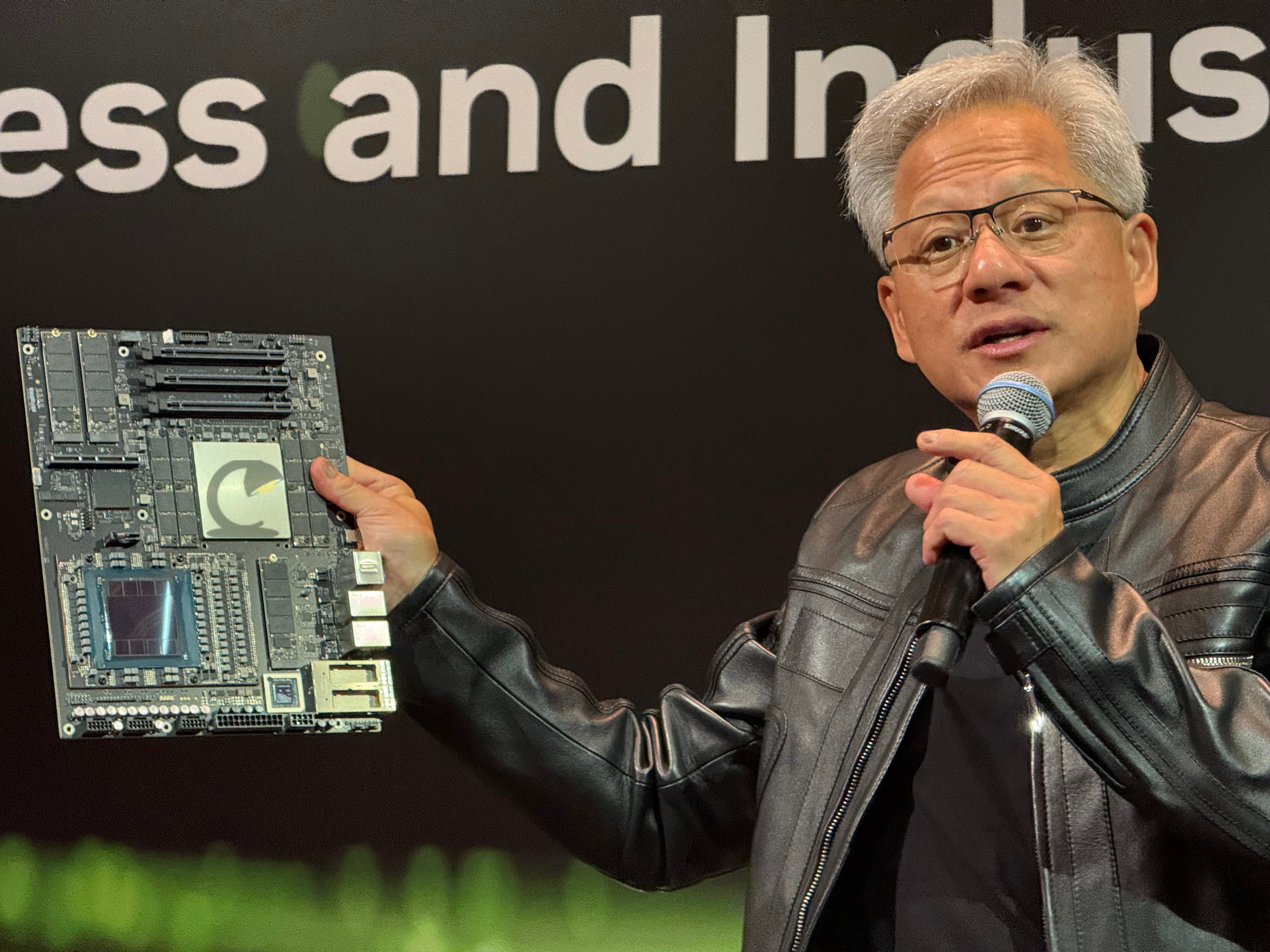
I’ll lean heavily on Jensen Huang’s words to construct my steel man position, but I am not quoting him directly nor will my thesis be an exact replica of his argument. I am taking what I see as the best of his logic and then adding to it.
Culpium’s Steel-man Argument for Selling High-end GPUs to China
If China doesn’t get access to the best technology, the argument goes, then it’ll be incentivized to build its own. To get to the essence of this issue, we need to get into the mechanics of how Chinese innovation works. To outsiders, it’s easy to think of the entire nation, its industry, and its economy merely marching to the beat of President Xi Jinping’s drum. Xi says “make chips” and 1.4 billion people respond in unison “how fast?”
The nation doesn’t quite work like that. Xi and the Chinese Communist Party (CCP) set the overall tone and direction, and through various bureaucracies does get involved in the nitty gritty from time to time — like banning after-school tutoring. The government also allocates funds and otherwise deploys various carrots and sticks to make the country move in the “right” direction.
But, despite the name, China is not Communist. It has private ownership, a stock market, millions of entrepreneurs doing their own thing, and countless private companies following the ebb and flow of market forces. ByteDance, Alibaba, and Tencent are among them.1 Each is toiling away building and selling products, and that now includes various AI-related projects. To compete in AI, they need the best tools possible and the best AI hardware tools are built on Nvidia GPUs.
If Nvidia chips aren’t available, goes the “sell-to-China” argument then local suppliers like Huawei, Cambricon Technologies, MetaX, and Semiconductor Manufacturing International Corp. (SMIC) will fill the gap. Sure, they’re not as good as Nvidia, but they’re the best available and it’s a level playing field anyway.
More importantly for these second-choice suppliers, getting orders from domestic clients gives them revenue. This can then be ploughed back into R&D and capex which in turn allows these also-rans to get better, and bigger, and thus slowly close the gap on Nvidia.
If, however, Nvidia can sell its chips to China, then ByteDance, Alibaba and Tencent will just buy from the US giant and steal sales from the local alternatives. Nvidia, goes the argument, can suck up all the financial oxygen from Chinese chip rivals, stunting their growth.
The second plank of the Nvidia-addiction argument is CUDA. The Compute Unified Device Architecture (CUDA) is considered by many to be Nvidia’s true moat. AMD has some pretty solid GPUs that can compete with Nvidia’s offerings, while hyperscalers like Google and Amazon are designing and deploying their own custom-designed silicon. However, entire AI systems are built around not just Nvidia chips but its CUDA platform and swapping over is not easy. It can be done, but a lot of the power and efficiency advantages are lost.
Getting China’s vast and growing AI sector to build its systems on CUDA would mean Nvidia, and by extension Washington, has leverage over Beijing. Should Chinese leaders upset the US administration, then the White House, State Department, or Commerce could just pull the CUDA rug from under them. Just the threat of cutting off access might be enough to get Beijing feeling a little cooperative.
The final argument is that if Chinese companies are to spend billions of dollars per year on semiconductors, wouldn’t it be best that such money flows into American pockets? Doing so would certainly help rebalance the large trade deficit, boost the US economy, and help American taxpayers.
So that’s the steel-man case for why the US should allow Nvidia to sell a selection of high-end GPUs to China. I’ve tried to be intellectually honest in constructing this argument. If you feel I haven’t, then please let me know by email or comments.
Now, let me tell you why I still think it’s a mistake.
In my 25 years covering this space I have never seen any foreign company establish an unassailable position in the China market. From cars to pharmaceuticals, and most certainly in tech, Chinese companies have worked hard to replace foreign firms. And Beijing has helped give outsiders the boot as soon as locals could fill the gap.
Adjunct to this observation is that Nvidia has proudly outlined how its chips can help design chips. It even has a platform called cuLitho — an amalgam of the words CUDA and lithography.
“cuLitho is a library with optimized tools and algorithms for GPU-accelerating computational lithography and the manufacturing process of semiconductors by orders of magnitude over current CPU-based methods.” : Nvidia Website.
With better chips at their disposal, Chinese tech firms can and will use Nvidia’s technology to design and manufacture chips to replace Nvidia itself.
Another reason why I think the reliance-and-addiction thesis is flawed is that lack of access to foreign chips was never a spur for Chinese semiconductor development. This argument was floated often during the Huawei saga, when the US cut the Chinese telecommunications giant off from American technology. But it’s simply not true. China has spent hundreds of billions of dollars over at least the past quarter century trying to advance its semiconductor prowess. Cutting China off from better technology in no way helps this effort, it can only stifle it.
Technology independence has been a stated goal of the Chinese government for decades, with a heightened sense of urgency under Xi Jinping. Not being able to buy Nvidia chips may raise the temperature a little, but the course was set long before China even knew who Nvidia was.
I’d be remiss if I didn’t make mention of the bilateral political economics of President Trump’s decision. He clearly wants to make a deal with Beijing, and this seems to be some kind of conciliatory move. But there’s been enough column-inches devoted to that angle already. You wouldn’t believe me if I told you that I know what Trump is thinking, so I won’t bother trying.
Thanks for reading.
More from Culpium:


I am not claiming that they’re China’s AI leaders. They are, however, among the largest tech companies in China and are looking to AI to expand.