

TSMC to Musk: There's No Shortcuts in the Chip Business
[Opinion] CC Wei is playing tortoise as Elon Musk takes the role of hare in the global AI chip race.

Good Evening from Taipei,
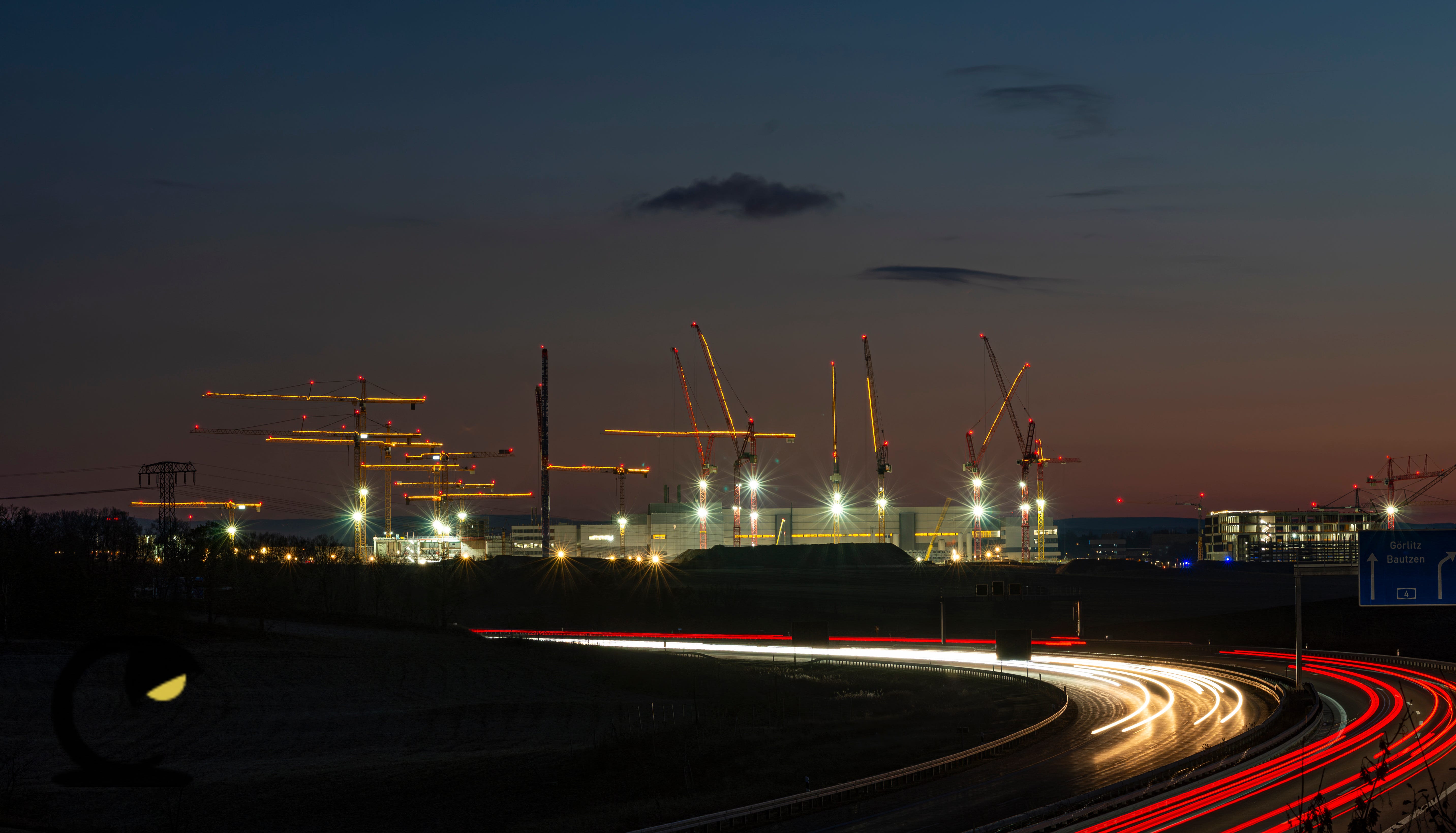
TSMC’s first-quarter earnings were a display of records across the board: revenue, gross margin, operating profit, net income, wafer shipments, and even ASP. Investors ought to be delighted by what they see.
But I can imagine clients are disappointed.
Not only did TSMC take more of the semiconductor value chain for themselves than ever before, the Taiwanese giant also failed to deliver an upgraded spending forecast for 2026. The best CFO Wendell Huang could offer was to narrow TSMC’s outlook to the “upper end” of the $52 billion to $56 billion capex range it announced in January.
There’s a chance this figure will get a bump later in the year, but the $11.1 billion it spent in 1Q — lower than the $11.5 billion it forked out the prior quarter — means the already backend-loaded spending plan doesn’t leave a lot of room to purchase and install a significantly larger amount of capacity this year.
It’s not all TSMC’s fault. The company needs to secure land, build shells, install utilities, kit out clean rooms, and spin up very complicated equipment. It doesn’t do any of this alone.
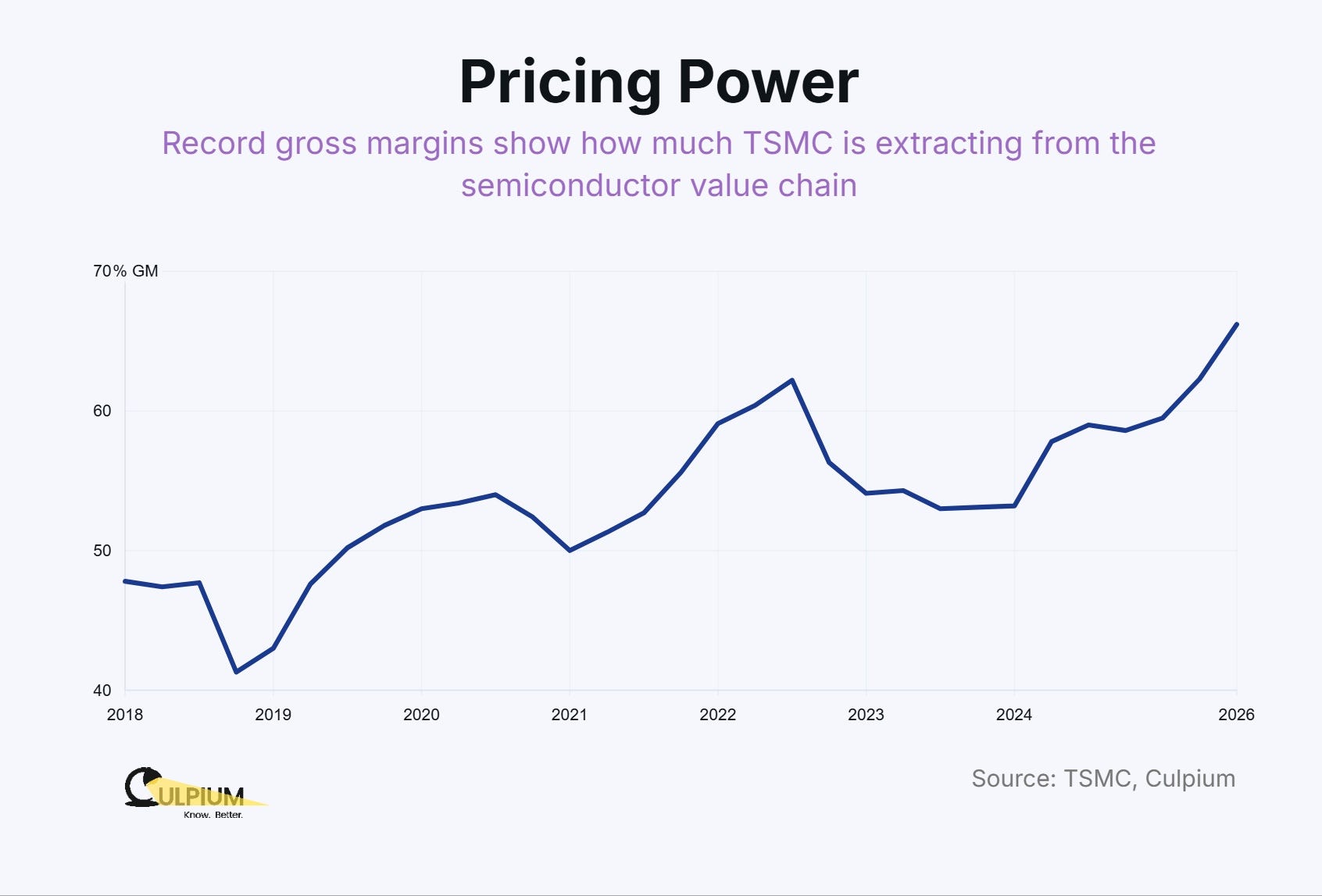
Despite the challenges, TSMC wafer shipments grew 28.1% year-over-year in the March quarter, the fastest pace in six years. Sedate growth in recent quarters was due more to supply constraints than demand, so this jump is an indication that new capacity really is coming online.
In addition, TSMC has amended its long-time business model of building new fabs instead of retooling existing ones. Holding onto and operating a chip factory with old equipment and technology is highly profitable because the major cost has already been depreciated. An old fab is a cashcow, a new one is a money sink.
Yet to meet customer needs, TSMC has shuttered 6-inch and 8-inch lines to make room for leading-edge capacity. On paper, that’s not a financially optimal move, but CEO CC Wei likely sees it as a strategically savvy one because it’s the fastest option that he has available to quickly boost supply given his many constraints.
Still, frustration with what many blame as TSMC’s inability or unwillingness to expand has attracted accusations that the Taiwanese company alone is the major speed brake on the world’s AI future. I’ve written before that I think this is untrue and unfair.
Today, I’d note that I haven’t heard a peep out of those same critics with regards to the global shortage of memory chips. Dell CEO and founder Michael Dell was recently cited as saying that “a structure is forming where total memory demand increases by approximately 625 times.” Yikes!

The desire to do an end-run around “the TSMC problem” recently spurred Elon Musk to start moving on plans to get into the chip-fabrication game, and has roped in Intel to help. Details are hazy, but I suspect Musk/Tesla will license technology from Intel and become an important financial backer of Intel’s future expansion plans. Heck, Musk should go all the way and just buy Intel, I say.
Wei seems almost amused at the prospect of Elon Musk soon discovering what he already knows. Something Intel knows, and Samsung knows, and GlobalFoundries knows. And that IBM and Motorola once knew: Making chips is hard.
“There are no shortcuts. The fundamental rules of the foundry game have never changed,” Wei told investors Thursday when asked his thoughts on Tesla and Intel’s plans for Terafab. “They need technology leadership, manufacturing excellence, and customer trust. And most of all service.”
Wei is currently overseeing capacity expansion in four countries across three continents, making him the world’s most preeminent expert on constructing semiconductor factories.
It takes two to three years to build a new fab, and another year or two to ramp up capacity, Wei noted — “no shortcuts.”
Of course, Musk’s move might be a massive headfake, designed to pressure TSMC to expand even quicker so that he can get on with the task of launching AI data centers in space. If so, Wei isn’t buying it, and he’s certainly not about to accelerate TSMC’s growth trajectory to just to stave off a possible loss of orders to Intel and Terafab.
“We repeatedly say that we prepare capacity to meet customers’ demand, not because of our competitor and not because of other considerations,” he said. “The most important one is our customers’ demand, and they work with TSMC so that we plan our capacity and our capital expense.”
Of course, this might be TSMC’s own psyops. The flipside to the “expand now, pay for it later” thesis is that extra industry capacity would give clients more leverage when a slowdown comes, especially since a chipmaker’s capital costs are baked in to its balance sheet and income statement. Seeding doubts into Musk’s mind, Inception style, could pay off bigtime if the world’s richest man later gets cold feet.
Musk’s plan is to scale from an initial output of 100,000 wafers per month to an eventual capacity of one million. Although he didn’t give a timeline, the urgency of his galactic mission suggests that he’d want to do so in under a decade. It took TSMC 37 years to reach the same point. That might make the incumbent chipmaker a bit of a tortoise, but in a few years the hare may learn for himself that there truly are no shortcuts.
Thanks for reading.
A note about emails: I noticed that Substack has had some email issues recently, and your account may have switched to an app-first “Prefer Push” setting. Take a moment to review your settings to ensure you’re receiving articles in the manner you prefer.


